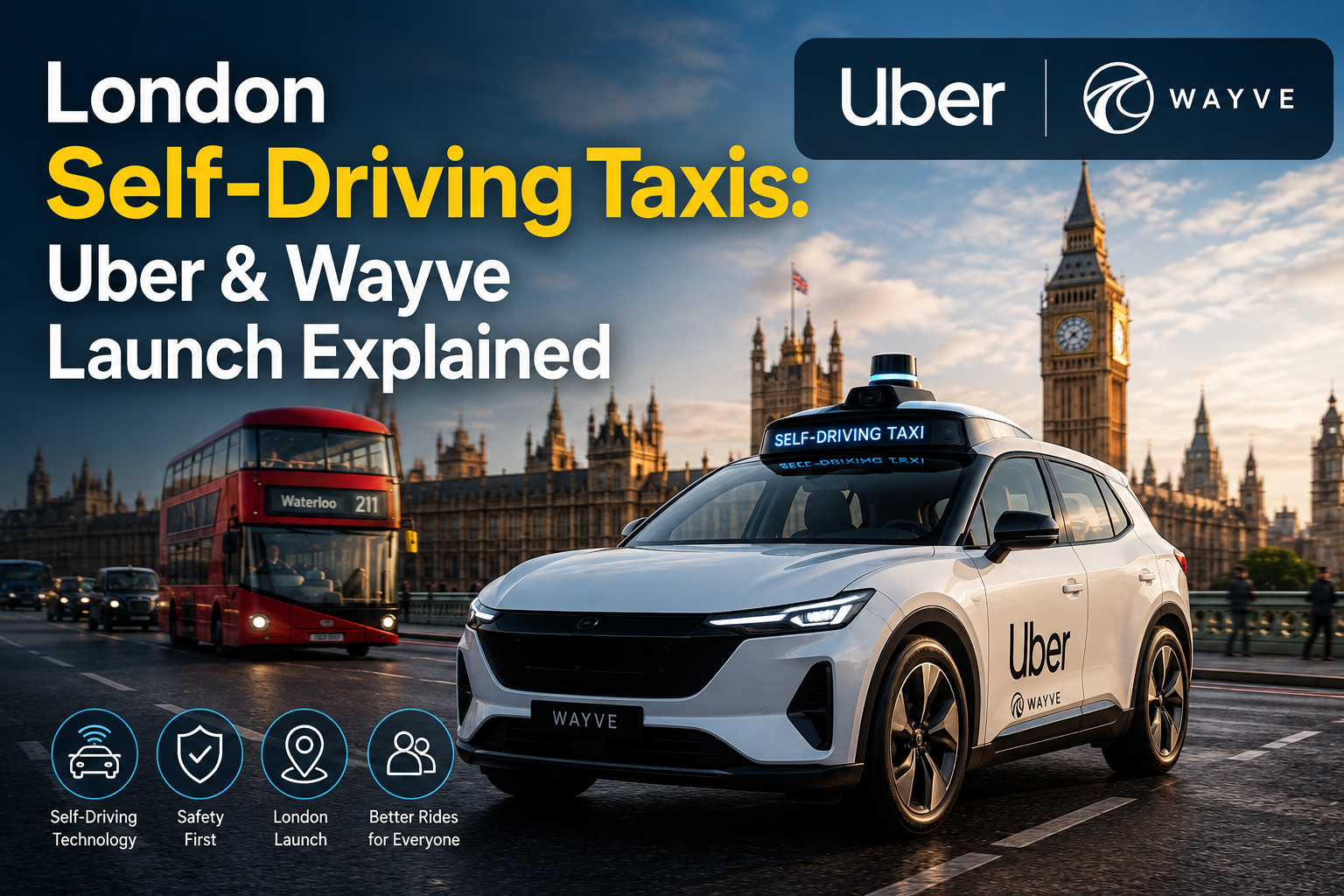
London Self-Driving Taxis: Uber & Wayve Launch Explained









On September 3, 2026, British AI company Wayve and Uber launched supervised autonomous rides across the capital giving Londoners their first real chance to book an AI driven car through the Uber app.
Quick summary:
A small fleet of electric Ford Mustang Mach E cars, fitted with Wayve’s AI Driver, is now bookable via UberX, Uber Electric, and Uber Comfort. Every vehicle still carries a trained, TfL licensed private hire driver so this is supervised autonomy, not a fully driverless taxi yet.
Key Facts at a Glance
| Detail | Information |
|---|---|
| Launch date | September 3, 2026 |
| Companies | Uber + Wayve |
| Vehicle model | Electric Ford Mustang Mach-E |
| Technology | Wayve AI Driver (AV2.0) |
| Human driver required? | Yes — TfL-licensed, supervised |
| Booking method | Standard Uber app (UberX, Electric, Comfort) |
| Extra cost to riders? | No, during initial launch |
| Airport coverage | Not included initially |
| Riders opted in | 140,000+ |
| Regulatory milestone | TfL granted PHV licences to Wayve AVs in August 2026 |
| Fleet cap | Up to 15 vehicles, one-year supervised trial (TfL-approved) |
| Partnership origin | Announced August 29, 2024 (Uber strategic investment in Wayve) |
| Future expansion | Nissan LEAF (Wayve tech) planned for Tokyo, late 2026 |
| Uber’s global AV goal | Facilitating AV trips in up to 15 cities by end of 2026; aiming to be the largest AV trip facilitator worldwide by 2029 |
What Happened in London Today?
Latest Technology News: Uber and Wayve officially started supervised autonomous rides across London today, using a small fleet of electric Ford Mustang Mach-E vehicles. Passengers requesting UberX, Uber Electric, or Uber Comfort may be matched with a Wayve vehicle, and there’s no additional autonomous-ride fee during the launch.
Passengers also get a choice: if matched with a Wayve vehicle, they can accept the ride or switch to a conventional car before it arrives. At launch, service covers London but excludes airports, and Wayve vehicles are being introduced gradually rather than replacing the wider Uber fleet allowing both companies to learn from real passenger journeys before scaling up.
Are London’s Self-Driving Taxis Fully Driverless?
No not yet. This is the single most important fact to understand.
The vehicles can drive autonomously, but a trained and TfL licensed private hire driver remains onboard throughout the supervised service, monitoring the system and ready to take control when required. That means this should be described as supervised autonomous driving, not a completely driverless taxi service a distinction that matters because fully driverless passenger services carry different safety and regulatory requirements.
For passengers, the human driver adds a real safety layer, while also giving Wayve more real world experience before attempting broader autonomy.
What Passengers Should Know
- Wayve vehicles are booked through the standard Uber app no separate app needed
- The cars are electric Ford Mustang Mach-E models
- A trained, TfL-licensed private hire driver remains onboard
- Passengers can accept or decline a Wayve ride
- No extra charge applies during the launch phase
- Service covers London but excludes airports
- More than 140,000 London users have already opted in
How Does Wayve’s AI Driver Work?
Wayve calls its approach AV2.0 an AI based system designed to learn from driving experience rather than depend mainly on traditional high definition maps and hand coded rules, with the AI Driver able to adapt as it gains experience.
The comparison to human driving is useful here: a person doesn’t need a perfect map of every street to drive somewhere new they observe the road and react to what happens around them. Wayve is building AI that works similarly, using cameras, radar, and other sensors to interpret its environment and make driving decisions in real time.
That said, the technology can’t automatically solve every road situation — which is exactly why testing in a city as complex as London matters.
Why London Is a Difficult Test for Self-Driving Cars
London combines narrow streets, large junctions, heavy traffic, and constantly shifting conditions. An autonomous vehicle here has to share the road with:
- Double-decker buses
- Black cabs
- Cyclists and motorcyclists
- Pedestrians
- Delivery vehicles
- Emergency vehicles
- Temporary roadworks
- Heavy, unpredictable traffic
The real challenge isn’t just recognizing these road users it’s predicting what they’ll do next: a cyclist changing direction suddenly, a pedestrian stepping toward the road, a bus blocking the vehicle’s view, or roadworks forcing an unusual lane change. That’s what makes London such a valuable (and difficult) proving ground for Wayve’s AI Driver.
More Than 140,000 Londoners Have Opted In
Public interest has grown fast Uber says more than 140,000 Londoners have opted in for a Wayve ride, up sharply from the 100,000+ reported in August.
With a small initial fleet, that creates a real gap between interest and availability, which itself is useful: some riders will be eager to try autonomous driving, others will prefer a human driver, and both reactions give Uber and Wayve valuable data on passenger comfort with the technology.
Why Uber and Wayve Make Sense as Partners
Wayve focuses on autonomous driving technology; Uber brings an existing ride-hailing platform, passenger network, and operational experience. Rather than building a new booking service from scratch, Wayve places its technology directly inside a platform people already use.
Importantly, this launch followed months of preparation
in August, Transport for London had already granted private hire vehicle licences to Wayve’s autonomous vehicles, clearing a key regulatory step before today’s public rollout.
The partnership itself goes back further: Uber and Wayve first announced their collaboration on August 29, 2024, when Uber made a strategic investment in Wayve as an extension of the company’s Series C funding round. Today’s London launch is also just the start of a much bigger global rollout Uber says it’s on track to facilitate autonomous vehicle trips in as many as 15 cities worldwide by the end of 2026, with ambitions to become the largest facilitator of AV trips globally by 2029.
Why This Matters for British AI
Wayve is a British AI company headquartered in London, and has been developing and training its technology on London’s challenging roads since 2018. That gives today’s launch significance beyond transport most AI conversation centers on chatbots and generative tools, while autonomous driving represents “embodied AI,” where software must interpret the physical world and make moving decisions in real time.
If Wayve scales successfully, the project could strengthen Britain’s position in autonomous mobility, robotics, and computer vision.
Will Robotaxis Replace London’s Taxi Drivers?
Not in the near term. The service still requires a trained human driver, and the initial fleet is small relative to London’s wider taxi and private hire market.
Longer term, Uber has described a hybrid network model autonomous and human driven vehicles operating side by side which looks far more realistic than a sudden industry wide switch, since some passengers will always prefer a human driver or need assistance autonomous vehicles can’t yet provide.
Safety Will Decide Whether the Technology Succeeds
The biggest challenge isn’t generating excitement it’s proving consistent safety across sudden pedestrian movements, cyclists, emergency vehicles, road closures, and unpredictable traffic.
The onboard safety driver is an important backup during this phase, but long-term success depends on how the AI performs with less human intervention over time. Public trust matters just as much as the technology itself repeated safe performance, not a single demo, is what will change how people feel about riding in one of these vehicles.
London Is Becoming an Important Global Robotaxi Market
Wayve and Uber aren’t alone Waymo and Baidu are among the companies reportedly looking at London, meaning competition is likely to intensify as the market develops. That competition could push all providers to improve reliability and passenger experience, while giving UK regulators more real world evidence for future autonomous vehicle policy.
The Electric Vehicle Connection
The first Wayve vehicles are all electric Ford Mustang Mach E models, combining two major transport shifts electrification and autonomy in a single service. The two technologies are separate (an EV isn’t automatically autonomous, and vice versa), but they pair well because modern EVs are typically built around the kind of advanced software and sensor integration autonomous driving needs.
What Happens Next?
Uber says the service will grow gradually based on rider demand, technical readiness, and regulatory approval. The near term focus is learning from real passenger journeys traffic conditions, passenger reactions, and edge cases the AI needs to improve on.
Wayve’s ambitions extend beyond London too: the company’s technology is designed to work across different vehicle platforms and sensor configurations, with a Nissan LEAF powered by Wayve technology planned for a future Tokyo servic signalling that London is one part of a much larger global rollout plan.
Final Thoughts
London’s self-driving taxi launch is a real milestone, but it’s the start of a longer story, not the end of one. Uber and Wayve have introduced supervised autonomous rides using electric Ford Mustang Mach E vehicles, with trained, TfL licensed drivers onboard to oversee every journey.
The fleet is small, but the test is significant: heavy traffic, cyclists, pedestrians, buses, and constantly changing road conditions will put Wayve’s AI Driver through one of the toughest urban environments in the world. The real question isn’t whether these cars can drive themselves for part of a journey it’s whether they can do it safely, consistently, and in a way people trust.
Frequently Asked Questions
Are London’s self-driving taxis fully driverless? No. The current Wayve service is supervised a trained, TfL licensed private hire driver remains onboard and can take control when required.
How many self-driving taxis launched in London? The initial rollout uses a small fleet of electric Ford Mustang Mach-E vehicles, described by Uber as the first phase of the service.
Can passengers book a Wayve robotaxi directly? Wayve vehicles operate through the standard Uber app. Eligible passengers can be matched with a Wayve vehicle when requesting UberX, Uber Electric, or Uber Comfort.
Do Wayve robotaxis cost more? No additional autonomous vehicle fee applies during the launch the fare shown in the Uber app is the final price.
Who developed the autonomous driving technology? British AI company Wayve, headquartered in London, developed the AI Driver used in the launch vehicles.
Can the robotaxis travel to London airports? No. Airports are excluded from the initial operating area.
How many Londoners have opted in? Uber says more than 140,000 Londoners have opted in for the opportunity to receive a Wayve autonomous ride.
Will robotaxis replace London’s taxi drivers? Not at this stage. The service still uses a trained safety driver, and the initial autonomous fleet is small compared with London’s wider taxi and private hire market.
Why is the London robotaxi launch important? It marks the UK’s first autonomous ride hailing service and gives a British AI company the chance to test its technology with real passengers on some of the world’s most complex urban roads.
Tech News: Stay updated with the latest technology news, AI trends, digital innovations, and smart business developments.