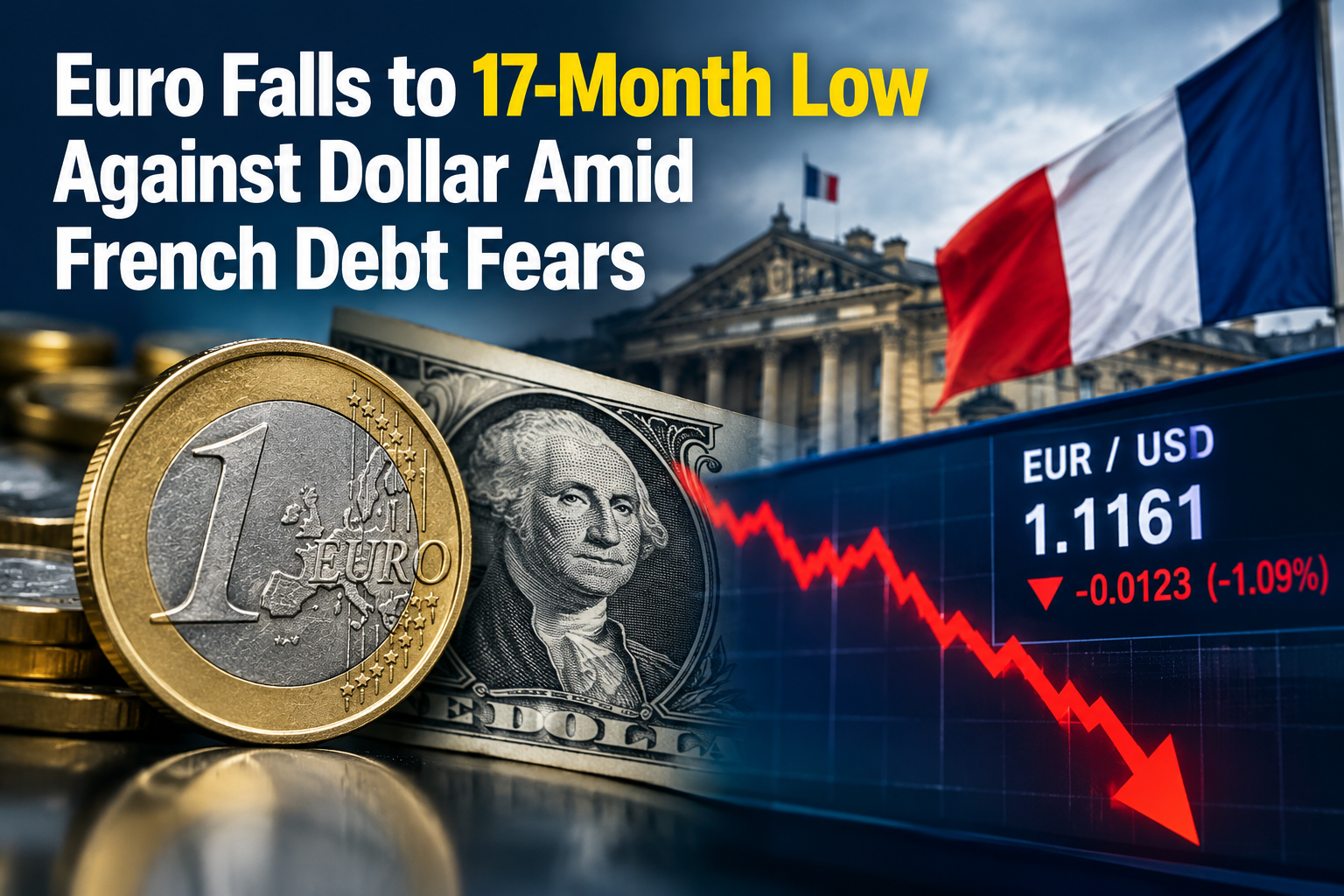
Euro Falls to 17-Month Low Against Dollar as French Debt Fears Rattle Markets










The euro has fallen to a 17-month low against the US dollar as growing concerns about France’s public finances and political uncertainty put renewed pressure on European financial markets. The euro dropped to around $1.1161 during Asian trading on Monday, October 5, its weakest level since May 2025. It later recovered some ground but remained under pressure as investors continued to assess France’s debt situation and the wider risks facing the eurozone.
The latest decline has added to a difficult period for the single European currency. The euro recorded its fourth consecutive weekly decline against the dollar, while investors have become increasingly concerned about the ability of France to control its budget deficit. At the same time, political uncertainty ahead of France’s 2027 presidential election has made the outlook even more complicated. Latest Business News
Why Is the Euro Falling?
The euro’s latest decline is closely connected to concerns about France’s fiscal position. France is the second-largest economy in the eurozone, but its government is facing pressure to control spending and reduce a large budget deficit. Investors are questioning whether the government can successfully introduce the fiscal measures needed to put public finances on a more sustainable path.
The problem is not only the size of France’s debt. Investors are also worried about the country’s political ability to pass difficult economic reforms. A divided parliament and opposition to spending cuts could make it harder for policymakers to deliver the measures financial markets are demanding.
As uncertainty increases, investors can demand higher returns for holding French government bonds. Higher borrowing costs can then put additional pressure on government finances, creating a difficult cycle for policymakers.
France’s Debt Crisis Concerns Grow
French government bonds have come under heavy pressure as investors reassess the country’s fiscal outlook. The yield on France’s 10-year government bonds rose to around 4.92% on Monday, while the French stock market also weakened. The CAC 40 fell around 0.9% to a six-month low as concerns about government finances weighed on investor sentiment.
Higher bond yields mean that France has to pay more when it borrows money. This matters because the government already has a substantial debt burden. If borrowing costs remain high for an extended period, interest payments can consume a larger share of government revenues.
For investors, the key question is whether France can convince markets that its debt situation will become more manageable. Until there is greater confidence in the government’s fiscal plans, French assets may continue to face pressure.
French-German Bond Spread Raises Alarm
One of the most closely watched indicators is the difference between French and German 10-year government bond yields. German government bonds are generally viewed as a safer asset within the eurozone, so the gap between the two yields provides an indication of the additional risk investors associate with French debt.
That spread moved above 150 basis points on Friday, reaching its widest level since the eurozone sovereign debt crisis of 2011. It later eased, but remained elevated at around 145 basis points. The sharp widening has become one of the strongest signs of growing investor concern about France.
A wider spread does not mean France is facing an immediate default. However, it shows that investors are demanding a larger premium to hold French government debt compared with German debt. If the spread remains elevated, it could make France’s borrowing costs even more difficult to manage.
France Faces a Difficult Budget Challenge
The French government is facing a major challenge as it attempts to control its budget deficit while dealing with political resistance. Market concerns have increased around the possibility that France’s deficit could reach about 6.5% of GDP if the government fails to pass its planned budget measures.
Reducing a large deficit usually requires spending cuts, higher taxes or a combination of both. These measures can be politically difficult, particularly when households and public-sector workers are already facing economic pressure.
France has also experienced protests linked to proposed budget measures. The political environment makes it harder for the government to guarantee that its plans will pass through parliament without significant changes.
This uncertainty is one of the reasons investors are demanding higher yields on French government bonds.
Political Uncertainty Adds More Pressure
France’s financial problems are becoming more sensitive because the country is approaching a presidential election in 2027. Political uncertainty can make investors more cautious because future governments may take different approaches to spending, taxation and debt management.
Markets are particularly concerned about whether the next political leadership will support fiscal consolidation or push for additional public spending. The possibility of a fragmented political environment adds another layer of risk.
For the euro, this matters because France is not a small economy. It is one of the most important members of the eurozone. Continued instability in French financial markets could therefore have wider implications for the single currency.
Could France Trigger Wider Eurozone Contagion?
The biggest concern for investors is that financial pressure on France could spread to other European markets.
During the eurozone sovereign debt crisis more than a decade ago, concerns about government finances in individual countries eventually affected markets across the currency bloc. Investors are now watching carefully to see whether the latest French bond-market weakness remains isolated or begins to create broader stress.
The situation is not the same as the 2011 crisis, and there is no evidence that France is currently facing an immediate sovereign default. European institutions also have more experience with financial-market stress than they did during the earlier crisis.
Nevertheless, the sharp move in French bond spreads has revived memories of that period and increased investor caution.
Spain Adds to Eurozone Political Uncertainty
France is not the only European country facing political uncertainty. Spain has also attracted market attention after Prime Minister Pedro Sanchez called a snap election for November 29.
The initial market reaction in Spain was relatively limited, but the election adds another political issue for investors to monitor. Spanish government bond yields moved only slightly higher, showing that markets currently view Spain’s situation differently from France’s.
Still, simultaneous political uncertainty in major eurozone economies can make investors more cautious about European assets. The concern is whether fiscal and political problems could eventually become broader regional issues.
The US Dollar Is Benefiting
While the euro has weakened, the US dollar has moved higher. The dollar index rose to around 102.33 on Monday after reaching 102.53, its highest level since April 2025.
The dollar continues to benefit from its position as one of the world’s leading reserve currencies. During periods of financial uncertainty, investors often move money toward assets they consider relatively safe and liquid.
The latest pressure on the euro has therefore created additional support for the dollar. The combination of French fiscal concerns and demand for US assets has made the euro-dollar exchange rate an important focus for global investors.
What About US Interest Rates?
US monetary policy is also influencing currency markets. Recent US employment data was weaker than expected, causing investors to sharply reduce expectations for a Federal Reserve rate increase in October.
Markets were pricing in only an 18% probability of an October Fed rate hike, compared with 64% a week earlier, according to CME FedWatch data cited by Reuters. Traders were still expecting the possibility of a rate increase later in the year.
Normally, expectations of lower US interest rates could put pressure on the dollar. However, the dollar has remained relatively strong because concerns about European fiscal stability are creating additional demand for US assets.
This shows that currency markets are influenced by relative economic and political risks, not simply by interest-rate expectations.
What Does a Weak Euro Mean for European Businesses?
A weaker euro can create both advantages and disadvantages for European businesses. Exporters can benefit because their products may become more competitive for customers outside the eurozone.
For example, a European manufacturer selling products in the United States could become more price competitive when the euro loses value against the dollar. This can potentially support overseas sales and improve the position of some exporters.
However, companies that rely heavily on imported goods face the opposite problem. A weaker euro makes many dollar-priced products more expensive when converted into euros.
Energy is particularly important because international oil markets are largely priced in US dollars. If the euro remains weak while energy prices remain high, European businesses could face additional cost pressures.
Could a Weak Euro Increase Inflation?
The euro’s weakness could also affect inflation across Europe. When the currency loses value, imported goods can become more expensive.
Energy is one of the biggest concerns because European countries rely heavily on imported energy. Higher import costs can eventually affect businesses and consumers through higher production and transportation costs.
This creates another challenge for the European Central Bank. The eurozone is already dealing with elevated inflation. Reuters reported on October 5 that eurozone inflation was running at around 3.8%, significantly above the ECB’s 2% target.
A weaker currency can therefore make the ECB’s inflation challenge more complicated, especially if energy prices remain elevated.
What Does the ECB Need to Watch?
The European Central Bank now faces a difficult policy environment. On one side, higher inflation could create pressure for further interest-rate increases. On the other side, rising government borrowing costs and political uncertainty could weaken economic activity.
Bundesbank President Joachim Nagel said on October 5 that inflationary risks remained significant, particularly because of energy prices and other supply pressures. However, he also said there were not yet clear signs that higher inflation had become embedded in wages and price-setting.
The ECB therefore has to balance inflation risks with financial stability and economic growth. Any major change in interest-rate expectations could also affect the euro.
What Could Happen to the Euro Next?
The next direction of the euro will depend heavily on developments in France. Investors will watch the French budget process, government borrowing costs and political developments closely.
If the French government manages to produce a credible fiscal plan and reduce political uncertainty, confidence in French bonds could improve. A narrowing of the French-German bond spread could then provide some support for the euro.
However, if political disagreements continue and borrowing costs remain elevated, investors could demand an even larger risk premium for French debt. That could place additional pressure on the euro.
The $1.10 level could become an important psychological threshold if the currency continues to weaken, although future movements will depend on developments in both Europe and the United States.
Is Another European Debt Crisis Starting?
The latest market moves have revived memories of the European sovereign debt crisis, but it would be premature to say that another crisis has already begun.
France is facing serious fiscal and political challenges, but the current situation is different from the conditions seen during the worst period of the eurozone crisis.
The immediate issue is investor confidence. If markets continue demanding higher yields for French debt, government borrowing costs could rise further. That would make it more difficult for France to improve its fiscal position.
The situation would become more concerning if financial stress spread to other major eurozone economies or caused a much broader sell-off in European government bonds.
For now, investors are watching the French bond market closely without treating the situation as a full-scale European debt crisis.
Why the Euro Matters to the US Economy
The euro’s decline is also important for American businesses and investors. The euro-dollar exchange rate affects companies with operations on both sides of the Atlantic.
US companies that generate revenue in Europe may see the dollar value of those earnings change when they are converted back into US dollars. A stronger dollar can also make European products cheaper for American consumers.
Currency movements can also affect international investment returns. For US investors holding European assets, changes in the euro can influence the final value of those investments when they are converted back into dollars.
This is why the euro’s latest decline is not only a European story. It has implications for businesses, investors and financial markets around the world.
European Markets Remain Under Pressure
The pressure on the euro has also been reflected in European financial markets. France’s CAC 40 index fell around 0.9% on Monday to a six-month low, while the broader STOXX 600 managed a modest gain.
The different performance shows that investors are focusing particularly closely on France rather than treating the entire European market as being in crisis.
However, higher government borrowing costs remain a concern across several major economies. Rising bond yields can increase financing costs for governments and companies, potentially affecting investment and economic growth.
What Investors Are Watching Now
Investors are now focused on whether France can regain market confidence. The French budget process will be particularly important because it will provide a clearer indication of whether the government can reduce its deficit while maintaining enough political support.
Bond yields will remain another key indicator. If French yields continue rising while German yields remain comparatively stable, the widening spread could signal further concern about French fiscal policy.
The euro will also remain sensitive to these developments. Any improvement in French political stability could support the currency, while renewed political conflict or a further bond sell-off could push it lower.
Final Thoughts
The euro’s fall to a 17-month low against the US dollar has placed France’s debt and political situation at the centre of global financial-market attention.
The euro dropped to around $1.1161, while the French-German 10-year bond spread briefly moved above 150 basis points, its highest level since the eurozone sovereign debt crisis of 2011.
France now faces a difficult balancing act. The government needs to control its deficit and reassure investors while dealing with political opposition and an approaching presidential election.
For European businesses, a weaker euro could provide some support for exporters but increase the cost of imports. For consumers, continued currency weakness could create additional pressure through imported goods and energy prices.
For the United States, a stronger dollar can influence international corporate earnings, trade and investment returns.
The current situation does not mean that another eurozone debt crisis has begun. However, the sharp movement in French bond spreads shows that investors are becoming increasingly sensitive to fiscal and political risks.
The coming months will be important for France, the eurozone and global markets. If French policymakers can restore confidence in the country’s fiscal plans, pressure on the euro may ease. If political uncertainty and borrowing costs continue to rise, the euro could face further downside pressure.
For now, the message from financial markets is clear: France’s debt, political stability and budget plans are becoming major drivers of the euro’s direction and the wider European market outlook.
Stay Connected With Tech News