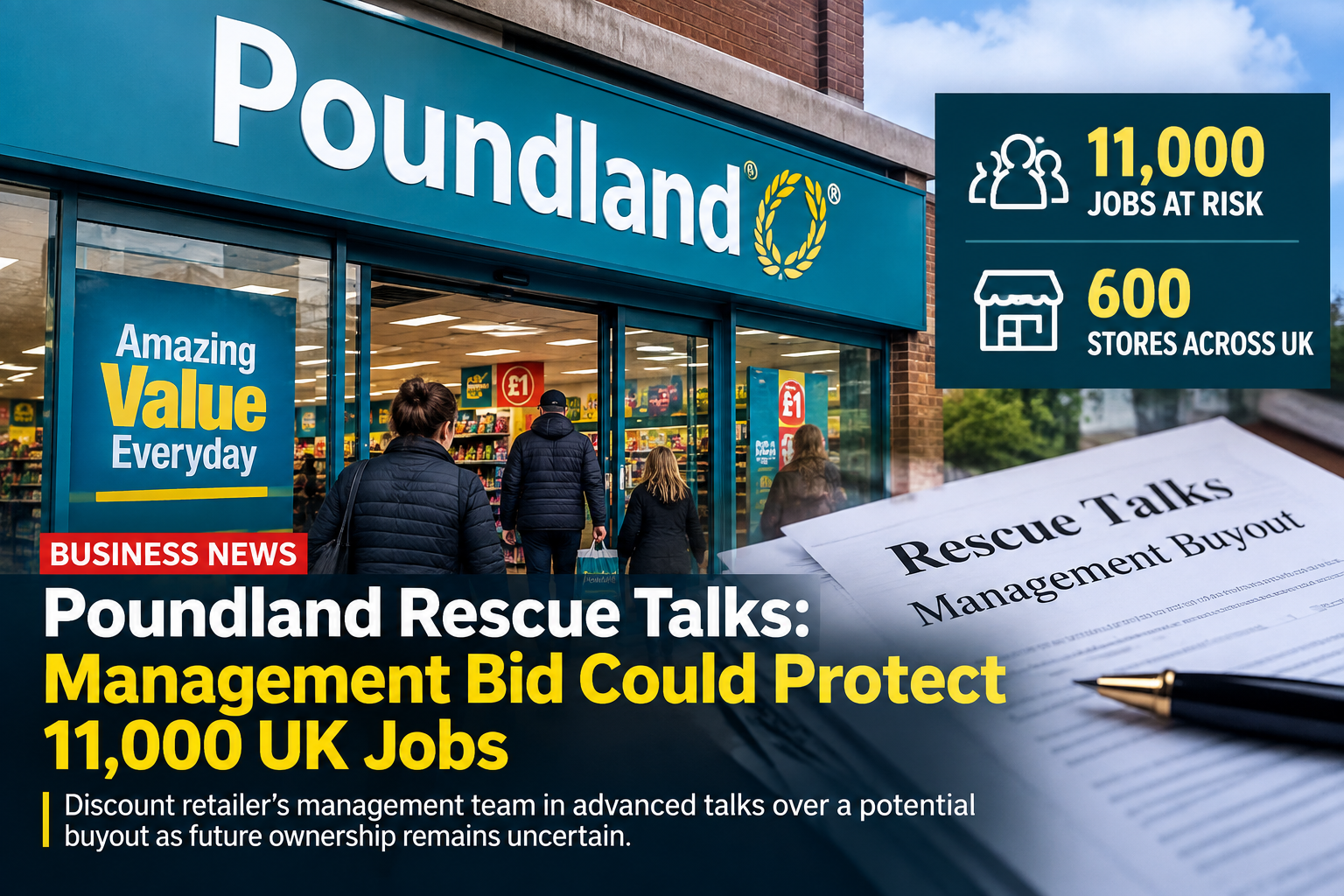
Poundland Buyout Talks: Can a Management Rescue Save 11,000 Jobs?









Latest Business News: The Poundland buyout talks could decide the future of one of Britain’s best-known discount chains. A team led by Managing Director Barry Williams and retail veteran Andy Bond is in advanced negotiations that could protect around 11,000 jobs. The chain’s sales have just turned positive for the first time in a long stretch. Both things are happening while the current owner, US firm Gordon Brothers, runs a formal sale process with a Christmas deadline in mind.
Here is what is happening, how Poundland got to this point, and what could happen next.
What’s Happening in the Poundland Buyout Talks
Poundland’s management is negotiating with a financial backer whose identity has not been made public. The backer is understood to be already involved in the sale auction. If the deal goes ahead, it would become Poundland’s new owner. Management would receive an equity stake, and Williams would remain in charge.
The team is not made up of insiders alone. Andy Bond ran Poundland from 2016, then moved to its former parent, Pepco Group, before leaving in 2025. He is also known for a wider career in value retail, including a spell as chief executive of Asda. Pepco Group still holds a minority stake in Poundland and is understood to support the proposal.
The reports say the bidder has already shown it can fund the deal. They also say it is not Modella Capital or Fortress, the owner of Poundstretcher. Those two private equity firms had earlier been named as circling the retailer.
Reports suggest the management-backed approach is motivated by a wish to create a solvent outcome. That means one that keeps the business out of administration.
The Sale Process
Gordon Brothers appointed Alvarez & Marsal to run the sale, and the process opened on 2 September. The first round of bids has closed. Multiple suitors are reported to have bid. Some bids are said to cover a very large share of Poundland’s roughly 600 UK stores, if not the whole business.
The Financial Times reported that Gordon Brothers wants £30 million. City AM reported that this figure is meant to cover a shareholder loan of the same size, which Gordon Brothers inherited from Pepco. A price like that could deter some bidders, so it matters that a credible backer has come forward.
There is a second thread. Gordon Brothers is also weighing a separate sale of the roughly 70 Dealz stores in the Republic of Ireland. A combined transaction is still possible. The owner wants a deal done before fourth-quarter trading begins, so Christmas sales go to the new owner rather than to a business in limbo.
From £1 Shop to Struggling Chain
Poundland was founded in 1990 by Dave Dodd and Steven Smith on a simple promise: everything cost £1. That formula carried the business through decades of growth. It went through a management buyout in 2002, backed by Advent International for £50 million, and then kept growing. Shareholders approved a takeover in 2016, and Poundland later ended up inside Pepco Group.
That ownership era did not go well. By spring 2025, Pepco was warning that it could not expect major proceeds from a sale. It reported an 818-store Poundland chain with like-for-like sales down 7.3% in the half year to March 2025 and underlying EBITDA down 75%. It booked a non-cash impairment charge of €234 million and cut its outlook for the year.
Teneo was then selected to find a buyer. In June 2025, Gordon Brothers bought Poundland for a nominal £1.
The Damage on the Books
The most recent published accounts cover the year to September 2025. They show a pre-tax loss of £85.2 million on revenue of £1.55 billion. The losses were blamed on weak trading and an unpopular overhaul of the clothing ranges, including products sourced from the former parent.
The scale of the reset that followed was large. Under a restructuring plan approved by the High Court in August 2025, Poundland:
- Closed about 149 stores, with around 2,200 jobs lost
- Negotiated rent reductions
- Closed its distribution centres in Darton and Bilston, leaving two, in Wigan and Harlow
- Ended online sales
- Scrapped its Perks loyalty app
- Withdrew from frozen and most chilled food
The chain ended 2025 with 651 stores. The company says the closure programme is now complete, and the store count is about 650 including Ireland.
The Turnaround: What the Numbers Show
Poundland’s recovery has come in stages, and the early stages were painful. Like-for-like sales fell 2.9% in the quarter to 28 December 2025, even though the number of items sold rose. Volumes were up 9% in the revamped grocery ranges and 2% across the wider range. Cutting prices meant those volumes did not show up in sales value. In that first quarter the chain still made £17.3 million of EBITDA, £8.4 million more than a year earlier.
Over the nine months to 30 June 2026, like-for-like sales were down 1.5%, an improvement on the Christmas quarter. Volume sales were up 5% overall and 8% in grocery. Poundland also announced its first new store in two years.
The most recent update, published on 25 September, is the strongest yet. Poundland reports:
- Like-for-like sales up 3.3% in the fourth quarter on an unadjusted basis
- Growth of 6.4% once categories the chain has dropped, such as frozen food, are stripped out
- Weekly unadjusted growth above 5% in recent weeks
- General merchandise now contributing to growth, with clothing expected to help as autumn and winter ranges arrive
- A Halloween range trading ahead of expectations
Gordon Brothers forecasts an EBITDA improvement of about £80 million year on year. The company says it brought the update forward, before the quarter ended on 27 September, to counter misinformation about how strong the turnaround is.
Two cautions are worth keeping in mind. The £80 million is a forecast for EBITDA, not a figure for pre-tax profit. And the 6.4% figure is an adjusted number, so the 3.3% unadjusted figure is the cleaner comparison.
Why Price Simplicity Matters
A large part of the recovery is a return to the idea that made Poundland famous. About 60% of its grocery range is now priced at £1, following a back-to-basics strategy launched in summer 2025.
Williams has said that cost control has given the business a platform for growth, but that no sustainable turnaround can rest on cost management alone. That reflects a real tension in the story. Closing stores and cutting overheads can stop losses. Winning customers back needs ranges and prices they actually want.
The clothing business shows this clearly. The PEP&CO brand has been rebuilt after sales suffered from ranges bought from its former parent. It is a category with better margins than grocery, which makes it important to any new owner’s plans.
There is a fresh appointment too. Shaun Wills joined as chief financial officer in July, and he has said he is impressed by how quickly the turnaround has brought Poundland back to profitability and to sales growth.
Why This Deal Matters Beyond Poundland
Jobs: The Guardian’s reporting puts the number of jobs that could be saved at up to 11,000. Other outlets cite around 12,000 staff. Either way, this is a very large employer spread across UK towns and high streets, many of them in communities with limited retail alternatives.
The wider High Street: Retail has had a difficult year. The Original Factory Shop and Claire’s both collapsed. Poundland’s own history shows how quickly a business can slide from a “safe” discount model to crisis when costs rise and strategy drifts. A solvent solution for Poundland would take pressure off landlords and suppliers, and it would give shoppers on tight budgets one more affordable place to shop.
Suppliers: Manufacturers and distributors who supply Poundland want certainty. A clean ownership outcome before Christmas gives them that.
The Risks Ahead
Even if the talks succeed, nothing is guaranteed.
- The deal isn’t done. Reports describe advanced talks, not a signed agreement. Other bidders remain in the process, and Gordon Brothers can still choose a different route.
- The recovery is young. One quarter of positive like-for-like sales is encouraging, but the previous quarters were negative. Christmas is the first real test.
- Competition is intense. Poundland competes with other discount retailers and with supermarket discounters for the same budget-conscious shoppers.
- Price cuts squeeze margins. Volume growth only helps if the extra sales cover the cost of lower prices.
- The identity of the backer is unknown. Until the financial partner is named and terms are published, the long-term plan for stores, staff and debt remains unclear.
What to Watch Next
In the coming weeks, keep an eye on these developments:
- An announcement of a preferred bidder. This would show whether the management-backed proposal has won.
- The fate of the Irish business. A separate Deals sale or a combined deal would change the shape of the transaction.
- Christmas trading. Strong sales in the key period would strengthen the case for a healthy business.
- Supplier reaction. Confidence from suppliers is a good signal of how the market views the outcome.
- The next set of accounts. The last published loss of £85.2 million covers a period before the restructuring took full effect, so newer figures will show how far the business has really moved.
The Bottom Line
Poundland in autumn 2026 is not the same company that lost £85.2 million a year earlier. It is smaller, simpler and, on its own numbers, growing again. Whether that is enough depends on a deal that keeps the business under one roof and gives it the financial backing to compete.
For 11,000 or so employees, and for shoppers who rely on £1 prices, the outcome of these talks matters. The pieces of a rescue are visible: an experienced leadership team, a supportive minority shareholder, a backer said to be ready to fund a deal, and improving sales. What is missing is a signature. Stay Connected With Tech News