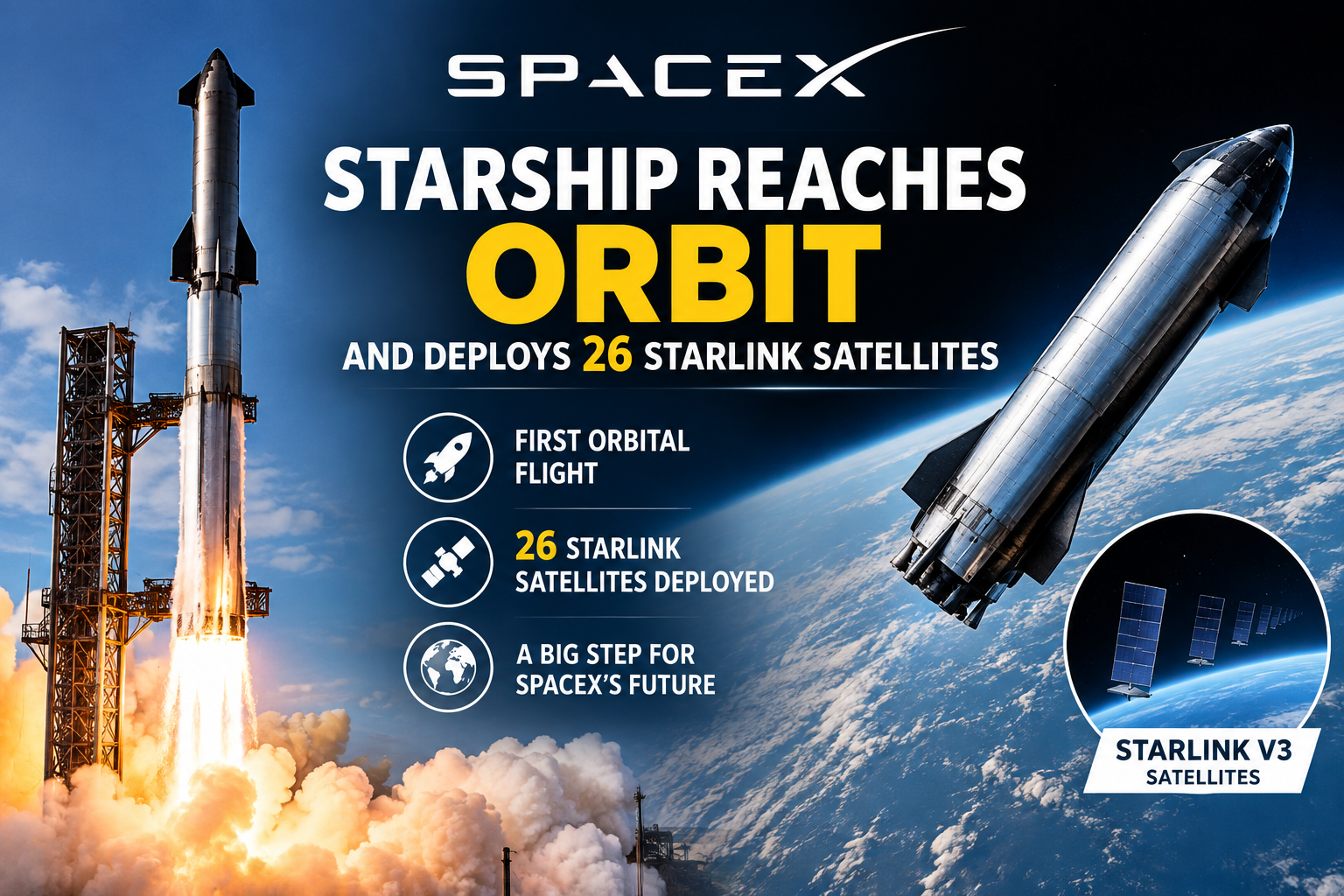
SpaceX Starship Reaches Orbit and Deploys 26 Starlink V3 Satellites in Major 2026 Milestone











SpaceX Starship has reached a major milestone after its 14th flight successfully reached Earth orbit and deployed 26 next-generation Starlink V3 satellites. The mission launched from SpaceX’s Starbase facility in South Texas on September 28, 2026, marking an important step in the company’s effort to develop a fully reusable heavy-lift launch system.
Latest Technology News: The flight was particularly significant because it demonstrated Starship’s ability to carry a large batch of Starlink satellites into orbit. Although Flight 13 had already become the first Starship mission to deploy the newer Starlink V3 satellites, Flight 14 represented another major step by reaching orbit and deploying 26 of the satellites during the mission.
SpaceX Starship Flight 14 Reaches Earth Orbit
The latest mission was designed to push Starship further into orbital operations. After liftoff from Starbase, the massive Starship vehicle continued through the early stages of its flight before reaching the conditions required for orbital operations.
Reaching Earth orbit is one of the most important objectives in Starship’s development because the vehicle is being designed for missions that require much greater performance than short suborbital test flights. An orbital mission requires the spacecraft to accelerate to extremely high speeds and follow a trajectory that allows it to remain around Earth rather than simply traveling upward and falling back.
Starship’s progress toward orbital missions is also important for SpaceX’s long-term plans for satellite deployment, commercial launches, lunar missions and eventually other deep-space activities.
26 Starlink V3 Satellites Deployed
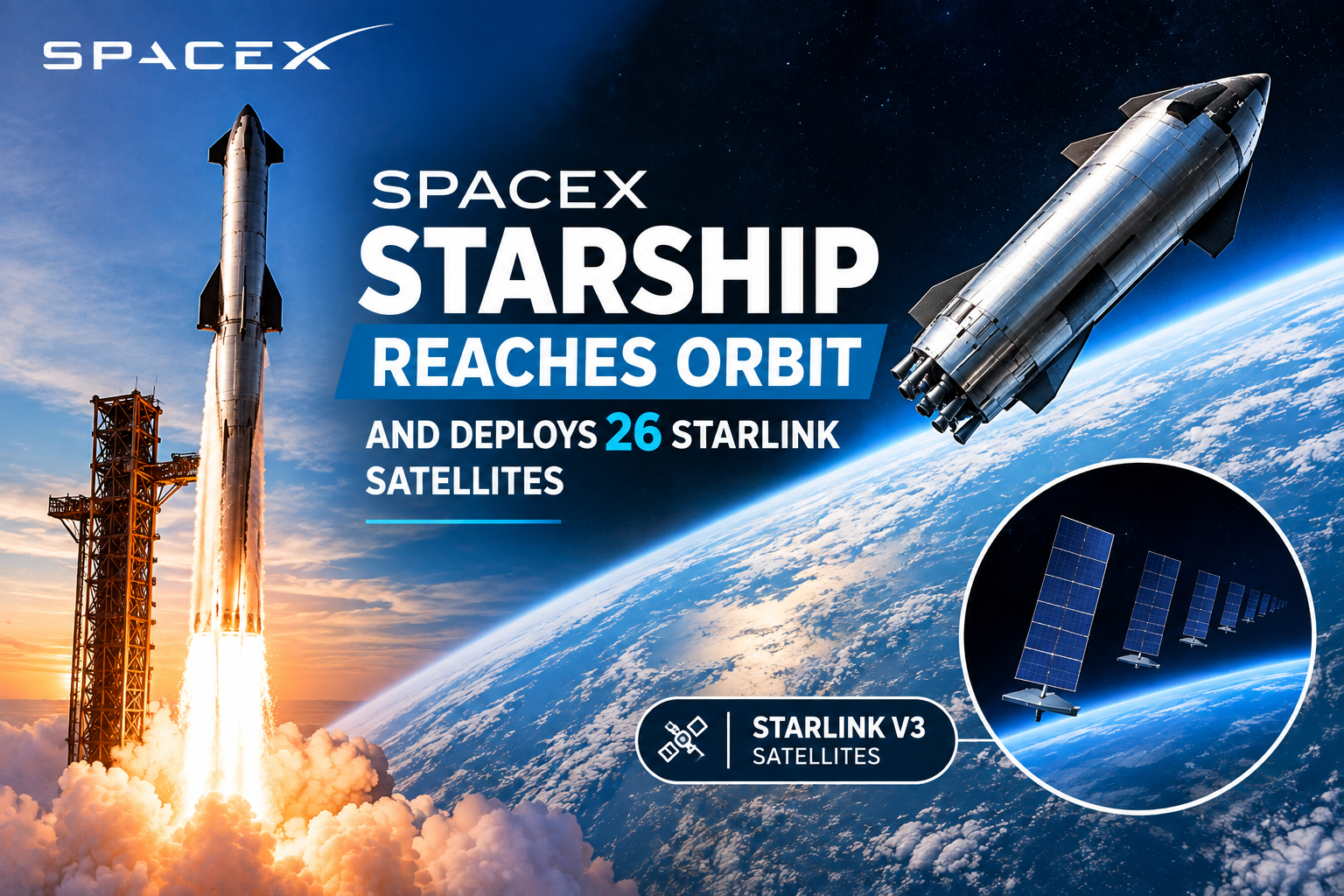
One of the biggest highlights of Flight 14 was the deployment of 26 Starlink V3 satellites. These satellites are part of SpaceX’s next-generation Starlink system, which is designed to provide greater network capacity and support the continued expansion of satellite internet services.
SpaceX has described Starlink V3 satellites as significantly more capable than earlier generations. According to company information, each V3 satellite is designed for up to 1 terabit per second of downlink capacity. SpaceX has also said that Starship could eventually deploy large numbers of these satellites in a single launch.
The deployment of 26 satellites therefore provides an important demonstration of how Starship could eventually support large-scale satellite launches. Rather than relying on smaller rockets for every batch, SpaceX is developing Starship with the goal of moving much larger payloads into orbit.
Flight 13 Was the First V3 Deployment
It is important to clarify one point about the Starlink V3 timeline. Flight 14 was not the first Starship mission to deploy Starlink V3 satellites.
SpaceX’s previous Flight 13 mission, launched in July 2026, was the first Starship flight to deploy the next-generation V3 satellites. The significance of Flight 14 was different because it combined orbital achievement with another large deployment of 26 V3 satellites.
This distinction matters because Starship’s development is progressing through a series of increasingly demanding tests. Each mission is providing additional information about the vehicle, its payload systems and its ability to perform more complex orbital operations.
An Engine Shut Down During the Mission
The mission was not completely without problems. During the flight, one of Starship’s engines shut down unexpectedly. Despite the engine issue, the mission continued through important stages and Starship completed its planned satellite deployment before the flight ended earlier than originally intended.
Engine performance is one of the most important areas being tested as SpaceX develops Starship. The vehicle uses multiple Raptor engines, and successful operation of these engines is essential for launch, ascent and future missions.
An unexpected engine shutdown does not by itself define the entire mission. Flight tests are designed to expose technical problems and provide engineers with data that can be used to improve future vehicles. SpaceX has repeatedly used this test-and-improve approach throughout Starship’s development.
Starship’s Controlled Reentry
After completing its orbital objectives, Starship eventually began its return phase. The spacecraft performed a controlled reentry before splashing down in the Pacific Ocean.
Controlled reentry is another important part of developing a reusable spacecraft. SpaceX wants Starship to eventually return from space and be recovered rather than being discarded after every mission.
The long-term goal is to make both Starship and its Super Heavy booster reusable. Achieving reliable reusability would be important for reducing turnaround time and enabling the high launch frequency that SpaceX is targeting.
Why Starlink V3 Matters to SpaceX
Starlink is one of the most commercially important parts of SpaceX’s business. The company operates a large satellite constellation designed to provide broadband internet connectivity in many parts of the world.
As demand for satellite internet grows, SpaceX needs to continue launching new satellites and replacing older spacecraft. More capable satellites can potentially increase network capacity while supporting additional users and services.
This is where Starship could become especially important. A much larger launch vehicle could transport more satellites in each mission, potentially changing how SpaceX expands and maintains the Starlink constellation.
SpaceX has said its Starship system could eventually deploy up to 60 Starlink V3 satellites on a single launch. The ability to move large numbers of satellites at once could become an important part of the company’s future launch strategy.
What Starship Flight 14 Means for Space Technology
The importance of Flight 14 goes beyond a single launch. The mission provided another demonstration of how Starship could eventually operate as a large orbital launch platform.
Traditional launch systems generally use expendable stages or have more limited reusability. SpaceX is attempting to develop a system where the major components can be recovered and flown again.
If that approach becomes reliable, it could change the economics and operational model of heavy-lift launches. However, Starship remains a development and testing program, so its long-term performance and commercial economics still need to be demonstrated through additional flights.
The latest mission therefore represents progress rather than the completion of Starship’s development.
Starship and NASA’s Artemis Program
Starship also has an important connection to NASA’s Artemis program. SpaceX is developing a version of Starship known as Starship Human Landing System, or Starship HLS, for planned lunar missions.
NASA’s current Artemis architecture has changed from earlier plans. Under the updated schedule, Artemis III is planned as a 2027 low Earth orbit demonstration mission, while Artemis IV is currently planned as the first Artemis lunar landing mission in early 2028.
SpaceX’s Starship HLS is being developed as part of this broader lunar architecture. The system is intended to transport astronauts between lunar orbit and the Moon’s surface during future Artemis missions.
However, additional testing and development are still required before Starship HLS can be considered ready for human lunar missions. NASA and its inspectors have also identified technical and schedule challenges associated with the human landing system program.
Why Reusability Is Important
One of the biggest ambitions behind Starship is full reusability. SpaceX wants the system to be capable of launching payloads, returning to Earth and flying again with limited refurbishment.
A reusable heavy-lift vehicle could potentially allow more frequent launches than a system that must be largely rebuilt after every mission. It could also support SpaceX’s plans for Starlink, commercial satellite launches, NASA missions and other future customers.
However, achieving this goal requires more than reaching orbit. SpaceX must demonstrate reliable launches, safe reentries, recovery operations, rapid refurbishment and repeated flights.
Flight 14 therefore represents one part of a much larger development process.
Starship Could Change Large Satellite Launches
The growing size and capability of Starlink V3 satellites makes Starship increasingly relevant to SpaceX’s satellite strategy. Larger and more capable satellites can require a launch system capable of carrying substantial mass into orbit.
Starship has been designed around the concept of moving very large payloads. Its large payload volume and heavy-lift capability could eventually allow SpaceX to launch many satellites in a single mission.
For Starlink, this could provide a way to expand the constellation at a faster pace. For the wider launch industry, successful Starship operations could create another option for companies and organizations that need to place large payloads into orbit.
The actual commercial impact will depend on Starship’s reliability, launch frequency, recovery performance and regulatory approvals over the coming years.
What Comes Next for SpaceX Starship?
The next stage of the Starship program will involve more test flights and increasingly complex missions. SpaceX will need to continue improving engine reliability, orbital operations, satellite deployment, thermal protection and recovery systems.
Future flights are also expected to provide more data about the performance of Starship and Super Heavy. The company’s long-term objective remains a highly reusable launch system capable of supporting missions ranging from satellite deployment to lunar exploration.
For Starlink, future Starship missions could become an important way to deploy larger numbers of next-generation satellites. For NASA, the progress of Starship HLS will remain closely connected to future Artemis lunar missions.
Frequently Asked Questions
What happened during SpaceX Starship Flight 14?
SpaceX Starship Flight 14 reached Earth orbit and deployed 26 next-generation Starlink V3 satellites. An engine also shut down unexpectedly during the flight, and the mission ended with a controlled reentry and Pacific splashdown.
Was Flight 14 the first Starship mission to deploy Starlink V3?
No. SpaceX’s Flight 13 in July 2026 was the first Starship mission to deploy next-generation Starlink V3 satellites. Flight 14 continued that work while reaching Earth orbit and deploying 26 V3 satellites.
How many Starlink V3 satellites were deployed?
Flight 14 deployed 26 Starlink V3 satellites.
Why is Starship important for Starlink?
Starship is being developed as a heavy-lift reusable launch vehicle capable of carrying large payloads. Its future capabilities could allow SpaceX to deploy larger batches of Starlink satellites during individual missions.
Is Starship ready for regular commercial operations?
Starship is still under development and testing. While the latest flight represents significant progress, additional successful flights and recovery demonstrations are needed before its full long-term commercial capability can be established.
Will Starship be used for NASA Moon missions?
SpaceX is developing Starship Human Landing System for NASA’s Artemis program. The current Artemis architecture identifies Artemis IV as the first planned lunar landing mission under the updated schedule, while Artemis III is planned as a 2027 low Earth orbit demonstration mission.
Conclusion
SpaceX Starship Flight 14 marks another important stage in the development of SpaceX’s next-generation launch system. The mission reached Earth orbit and deployed 26 Starlink V3 satellites, demonstrating Starship’s potential to support large-scale satellite deployment.
The flight also showed that important technical challenges remain. An engine shutdown and the mission’s early conclusion highlight why SpaceX continues to use flight testing to improve the vehicle.
For Starlink, the growing capabilities of Starship could eventually provide a powerful way to launch larger batches of next-generation satellites. For NASA, Starship’s continued development remains relevant to future Artemis lunar missions.
The biggest question now is how consistently SpaceX can repeat these achievements. More flights, successful recovery operations and additional testing will determine how quickly Starship moves from an experimental vehicle toward the highly reusable launch system SpaceX ultimately intends to build. Stay Connected With Tech News