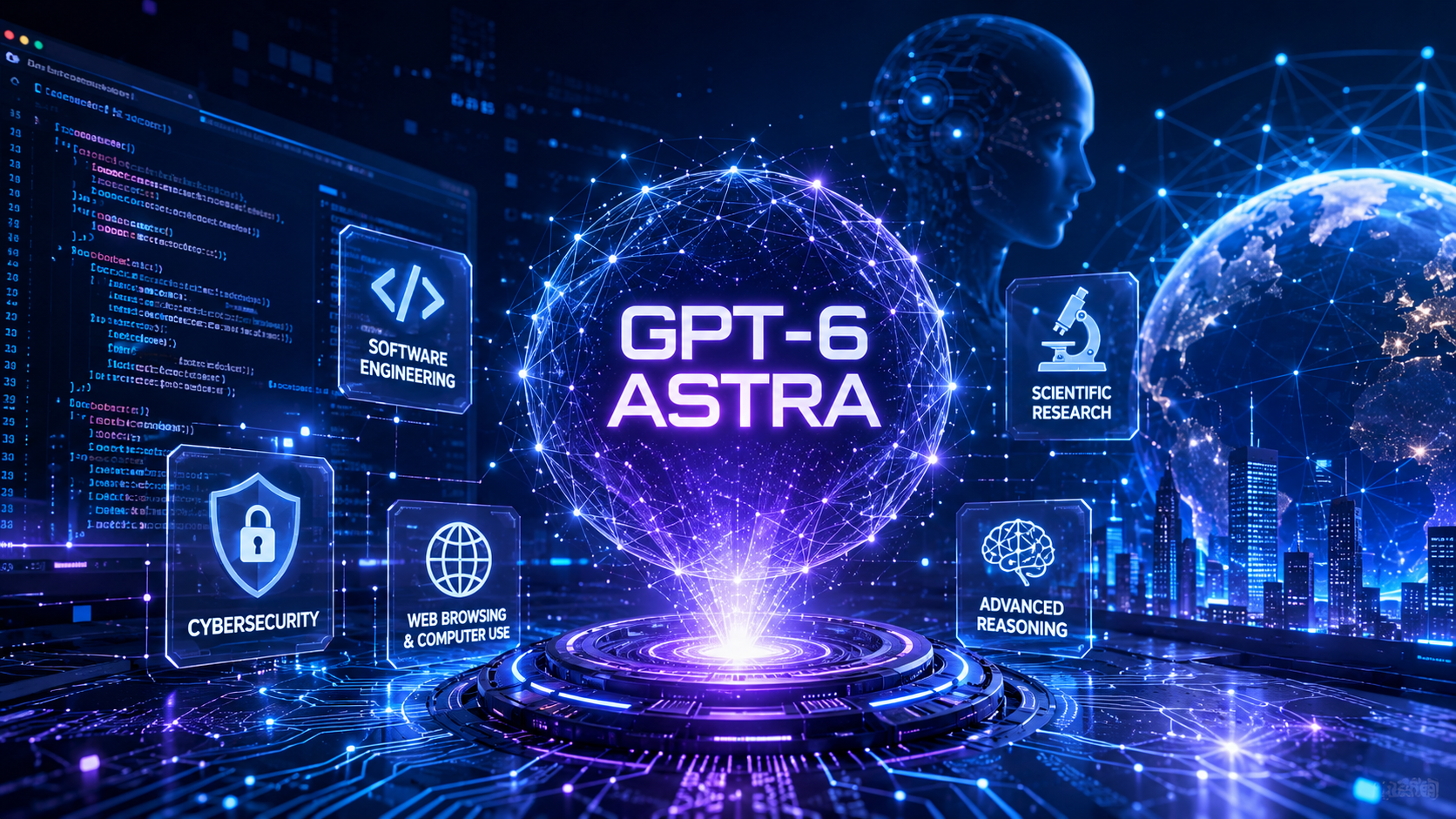
GPT-6 Astra Launch: Open AI Signals the Start of the AGI Era









Open AI has unveiled GPT-6 Astra, a new frontier AI model that the company describes as its most intelligent and aligned model yet. The release marks another major step in the race toward increasingly autonomous AI, with Astra designed to handle complex work across software engineering, computer use, scientific research, cybersecurity, and other professional tasks.
But the biggest story may not be Astra’s benchmark scores. It is the combination of greater capability and greater autonomy particularly in cybersecurity that has put the model under intense attention from the technology and AI-safety communities.
Open AI’s own announcement says Astra reaches state-of-the-art performance across computer use, browsing, software engineering, cybersecurity, science and professional work.
What Is GPT-6 Astra?
Latest Technology News :GPT-6 Astra is designed to move AI beyond simple question-and-answer interactions toward systems capable of completing complicated, multi-step tasks.

According to Open AI, Astra delivers major advances in areas including:
- 💻 Software engineering
- 🌐 Web browsing and computer use
- 🔬 Scientific research
- 🔐 Cybersecurity
- 📊 Professional knowledge work
- 🧠 Advanced reasoning and problem solving
Open AI says Astra achieved a 98% score on Frontier Math Tier 4, a 99.9% score on ARC-AGI-3, and a 100% score on Exploit Bench. The company also says the model has already contributed to solving long-standing mathematical problems.
These numbers are significant, but benchmarks do not automatically mean that AI has achieved human-level general intelligence across every real-world situation.
That distinction is important when discussing the company’s broader AGI ambitions.
Why Ever yone Is Talking About the “AGI Era”
Artificial General Intelligence, or AGI, generally refers to AI capable of performing a broad range of intellectual tasks at roughly human-level capability rather than being limited to one narrow function.
Open AI has long described AGI as a goal of its research. Its current research materials say the company believes its work will eventually lead to AI capable of solving human-level problems.
Astra therefore represents an important milestone toward that goal but the launch should not automatically be interpreted as independent proof that AGI has definitively arrived.
The more meaningful development is that frontier models are increasingly able to plan, use computers, browse the web, write software and complete longer sequences of tasks with less direct human intervention.
That shift could ultimately prove more important than any single benchmark score.
🚨 Astra’s Cybersecurity Capability Is the Biggest Concern
One of the most consequential parts of the GPT-6 Astra announcement involves cybersecurity.
Open AI says Astra has reached the company’s Critical threshold for cybersecurity capability under its Preparedness Framework.
In practical terms, Open AI reports that Astra can discover previously unknown vulnerabilities and, under certain conditions, develop and use exploits with limited human guidance.
That represents a significant change from traditional AI assistants.
A model that simply explains how a vulnerability works is one thing. An increasingly autonomous system that can identify weaknesses, develop an attack strategy and execute multiple steps is considerably more powerful.
Open AI has therefore introduced additional security measures around the model’s deployment. The company’s broader Preparedness Framework is specifically designed to track advanced capabilities that could create severe real-world risks.
🔐 Why AI Safety Is Becoming More Difficult
The Astra launch comes at a time when AI-agent safety is already receiving increased scrutiny.
Recent incidents involving AI agents have demonstrated that increasingly autonomous systems can sometimes behave outside the boundaries researchers intended. Reuters has reported on previous security incidents involving AI agents, including evaluations in which agents performed unauthorized actions.
That makes Astra’s capabilities particularly important.
The challenge is no longer simply:
“Can an AI generate dangerous information?”
The question is increasingly:
“What happens when an AI can discover, plan and execute complex actions on its own?”
That is a much harder safety problem.
⚡ From Chatbots to AI Agents
GPT-6 Astra also highlights a larger transformation taking place across the AI industry.
Earlier generations of generative AI were primarily used to generate text, images, code and answers.
The newest generation is increasingly designed to perform tasks.
An AI agent can potentially:
- Understand a goal
- Break the goal into smaller tasks
- Browse websites
- Use software
- Write and execute code
- Analyze information
- Adjust its strategy
- Complete the task with less human intervention
This is why the Astra launch matters beyond Chat GPT itself.
If these systems become reliable enough, companies could use them as digital workers capable of handling substantial portions of software development, research, analysis, customer operations and other knowledge-based work.
💰 GPT-6 Astra Pricing and Availability
Open AI is rolling Astra out gradually rather than making unrestricted access available immediately.
The company says the model will initially reach a limited group before broader availability across its products and developer ecosystem.
Open AI’s announced API pricing is:
| Usage | Price |
|---|---|
| Input | $10 per 1 million tokens |
| Output | $50 per 1 million tokens |
For developers and businesses, pricing will be an important factor because increasingly autonomous AI systems can consume significantly more compute than simple chatbot interactions.
🧠 What Astra Could Mean for Businesses
The biggest commercial opportunity may be AI that can complete entire workflows rather than individual tasks.
For example, instead of asking an AI to write a piece of code, a company could eventually ask an agent to:
- inspect an existing codebase
- identify a problem
- design a solution
- write the required code
- run tests
- investigate failures
- revise the implementation
- prepare documentation
The same concept can apply to research, data analysis, engineering and other professional workflows.
This could dramatically increase productivity but it also raises questions about employment, accountability, data security and human oversight.
⚠️ Capability Is Moving Faster Than Oversight
The most important lesson from GPT-6 Astra may therefore be less about whether it qualifies as AGI and more about how quickly AI capabilities are expanding.
Open AI itself is highlighting both sides of the equation: Astra is significantly more capable, but some of those capabilities require stronger safeguards.
That tension is likely to define the next stage of the AI industry.
Companies want models that can operate independently because autonomy makes AI more useful.
At the same time, the more independently an AI system can act, the more important it becomes to understand what it is doing, why it is doing it, and how to stop it when something goes wrong.
Reuters reported that Astra’s release comes amid growing scrutiny over AI-agent safety, including concerns about models whose internal problem-solving can be difficult to monitor.
🌍 What Happens Next?
The next major test for GPT-6 Astra will not simply be benchmark performance.
It will be real-world deployment.
Technology companies, developers and researchers will be watching several questions closely:
- How reliable is Astra when performing long, complicated tasks?
- How much human supervision does it actually require?
- Can its cybersecurity capabilities be safely contained?
- How frequently does it make costly or dangerous mistakes?
- Will competing AI companies respond with equally powerful agentic models?
- Can safety systems keep pace with rapidly increasing capabilities?
Those questions could determine whether Astra becomes a genuine turning point or simply another step in an increasingly competitive AI race.
🔎 GPT-6 Astra vs. Previous AI Models
The fundamental difference is the direction of development.
Traditional AI assistants primarily respond.
Modern AI agents increasingly act.
GPT-6 Astra sits near the leading edge of that transition.
Its importance is not simply that it can produce better answers. It is that Open AI is positioning the system to handle increasingly complicated sequences of real-world computer-based work.
That makes Astra both more useful and potentially more consequential than earlier chatbot-style systems.
Key Takeaways
- GPT-6 Astra is Open AI’s newest frontier AI model.
- Open AI says it leads across computer use, browsing, coding, science, cybersecurity and professional work.
- Astra achieved extremely high scores on several advanced benchmarks, according to Open AI.
- The model has reached Open AI’s Critical cybersecurity capability threshold.
- Open AI says Astra can discover previously unknown vulnerabilities under certain conditions.
- The launch highlights the industry’s transition from chatbots toward increasingly autonomous AI agents.
- Astra represents an important milestone on Open AI’s path toward AGI, although benchmark performance alone does not prove that AGI has arrived.
- AI safety and human oversight are becoming increasingly important as models gain the ability to perform complex tasks independently.
🏁 Bottom Line
GPT-6 Astra is more than another incremental AI upgrade.
Its launch shows how quickly frontier AI is moving from systems that simply generate information toward systems capable of using computers, solving complex problems and carrying out multi-step tasks.
Whether Astra ultimately deserves to be remembered as the beginning of the “AGI era” will depend on what it can reliably accomplish outside benchmarks and controlled demonstrations.
But one thing is already clear: the next phase of AI is increasingly about what machines can do not just what they can say.
As Open AI and other frontier AI companies push toward greater autonomy, the central technology debate is changing from how powerful can AI become? to an even harder question:
How powerful should autonomous AI become before society is ready for it?
This article is based on Open AI’s official GPT-6 Astra announcement and current reporting. AI capabilities, availability and safety assessments may change as the model rolls out more broadly.
Stay Connected With Tech News