
Amazon Raises $5.76 Billion in First Ever UK Bond Sale to Fuel AI Boom












Amazon just made history in the UK debt market and the reason behind it says everything about where Big Tech’s money is going in 2026.
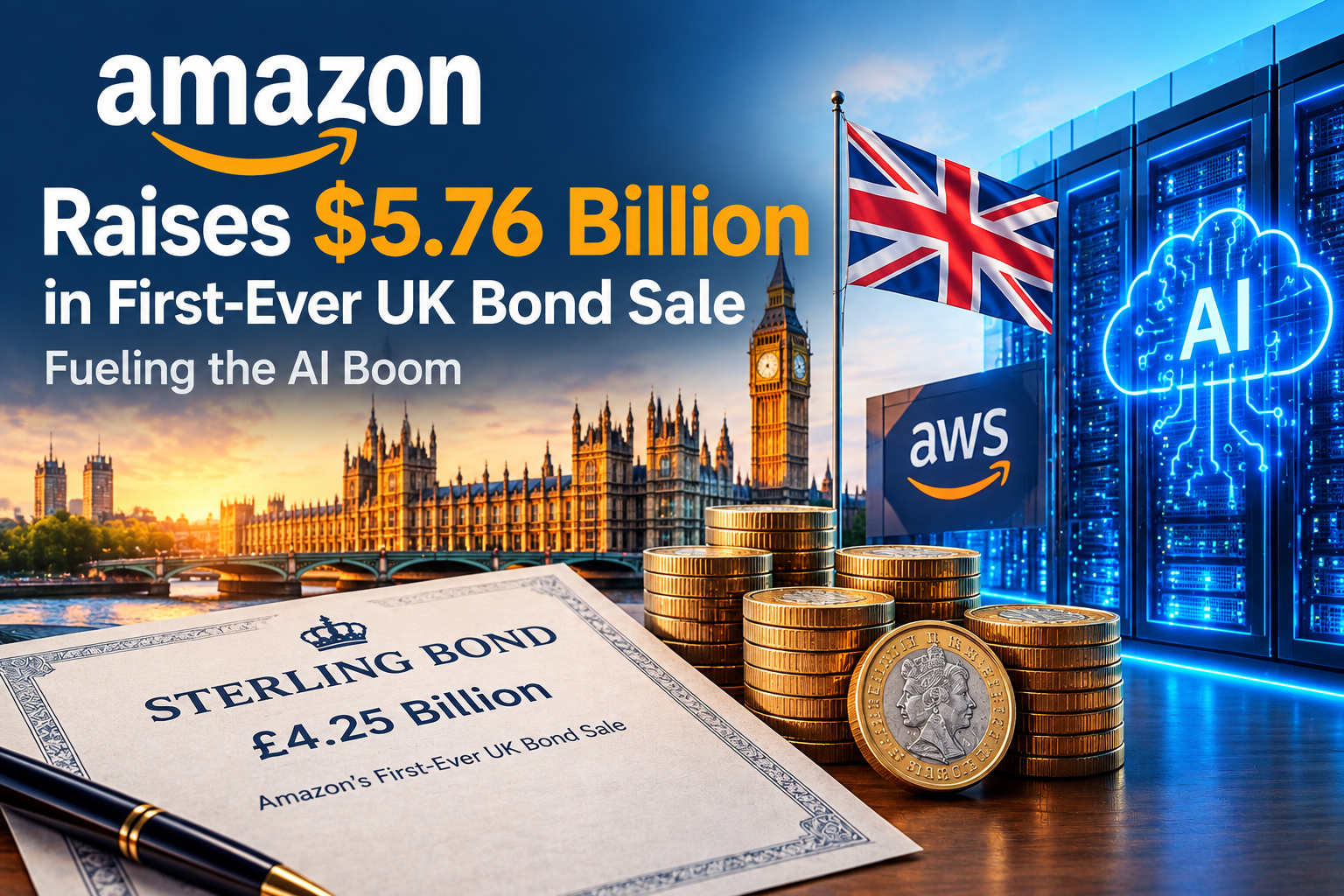
The e-commerce and cloud giant raised £4.25 billion (about $5.76 billion) through its first ever sterling-denominated bond sale, tapping British investors to help fund one of the most expensive technology races in history: artificial intelligence infrastructure.
This single transaction tells a much bigger story than just “Amazon borrowed money.” It’s a window into how the world’s largest technology companies are quietly rewriting their financial playbooks to keep up with the staggering costs of building AI at scale. For decades, companies like Amazon were known for sitting on mountains of cash. Now, even they are turning to global debt markets to keep the AI engine running.
Here’s everything you need to know about the deal, why it matters, and what it signals for the future of Big Tech spending.
What Happened
Latest Business News: Amazon priced a four part bond offering in British pounds — a first for the company. It was split into:
- £1.25 billion — 3-year bond
- £1 billion — 6-year bond
- £1 billion — 12-year bond
- £1 billion — 19-year bond
Yields on the bonds ranged between 5.2% and 6.7%, rising with longer maturities a normal pattern in bond markets, since investors demand higher returns for locking up money longer.
Demand was strong. Investors offered to buy more than £10.65 billion worth of bonds over twice what Amazon actually issued although that was a touch lower than the roughly £12 billion of interest seen before final pricing was set.
That gap between initial demand and final demand is a small but telling detail. It suggests that while investors are still eager to lend Amazon money, they’re also becoming more selective and price-sensitive as tech companies collectively pile into the debt markets. In other words, appetite for Big Tech debt remains healthy, but it isn’t unlimited or unconditional.
A Quick Primer: What Is a Sterling Bond Sale?
For readers less familiar with corporate finance, a bond is essentially a loan. When a company like Amazon issues a bond, it’s borrowing money from investors and promising to pay it back with interest over a set period of time. A “sterling bond” simply means the debt is issued and repaid in British pounds rather than US dollars.
Companies choose to issue bonds in different currencies for a few strategic reasons:
- Access to new investors: Issuing in sterling opens the door to UK and European institutional investors who may prefer to hold pound denominated assets.
- Currency diversification: Borrowing in multiple currencies reduces a company’s dependence on any single market.
- Favorable market conditions: Sometimes borrowing costs or investor appetite are more attractive in one currency market than another at a given time.
For Amazon, this sterling bond sale checks all three boxes, and it comes at a moment when the company’s borrowing needs are growing rapidly.
Why Is Amazon Borrowing So Much Money?
Simple answer: AI is expensive.
Amazon, through its cloud division AWS, is racing alongside Microsoft, Google (Alphabet), and Meta to build out the data centers, chips, servers, and power infrastructure needed to run next-generation AI systems. That kind of buildout doesn’t come cheap and increasingly, it’s not being paid for out of pocket.
Think about what actually goes into building AI infrastructure at the scale these companies operate:
- Data centers: Massive physical facilities that need to be built, powered, and cooled around the clock
- Advanced chips: Specialized processors designed for AI workloads, which are both expensive and often in short supply
- Networking equipment : The infrastructure that connects thousands of servers so they can work together efficiently
- Electricity infrastructure: AI training and inference consume enormous amounts of power, requiring upgrades to energy supply and, in some cases, dedicated power agreements
Each of these categories requires billions of dollars in upfront capital, long before any of it generates a single dollar of revenue. That mismatch huge upfront costs versus delayed and uncertain returns is exactly why companies are increasingly financing this buildout through debt rather than relying purely on operating cash flow.
Instead of draining cash reserves, these companies are turning to global bond markets. According to Reuters, hyper scalers (the biggest cloud and AI infrastructure companies) have already issued more than $200 billion in debt during 2026 more than double the total for all of 2025.
That’s not a small shift. It represents a fundamental change in how the largest technology companies in the world are choosing to fund growth. A decade ago, it would have been unusual to see companies with Amazon’s cash generating power turning so heavily to debt markets. Today, it’s becoming standard practice.
Amazon isn’t new to bond markets either. It has previously issued debt in euros, Swiss francs, and Canadian dollars. Pounds sterling is simply the newest tool in its financing toolkit and likely won’t be the last currency it taps as its capital needs continue to grow.
Amazon Isn’t Alone
This is part of a much bigger trend across Silicon Valley:
- Alphabet issued £5.5 billion in sterling bonds earlier in 2026
- Microsoft, Meta, and Oracle have also ramped up debt issuance to fund AI ambitions
What’s striking is how quickly this shift has happened. These are some of the most profitable companies on the planet businesses that, in previous years, were often criticized for hoarding too much cash rather than putting it to work. Now, the calculus has flipped. The scale of AI investment has grown so large, so fast, that even industry giants are choosing to supplement their own cash flow with borrowed capital rather than slow down their spending plans.
For years, Big Tech was seen as cash-rich and debt shy. That image is fading fast as the AI infrastructure race forces even the wealthiest companies to borrow at scale. Analysts increasingly describe this as an “arms race” mentality no major player wants to fall behind in AI capacity, even if it means taking on billions in new debt obligations to get there first.
This also raises the competitive stakes. If Amazon, Microsoft, Alphabet, and Meta are all racing to expand AI infrastructure using borrowed money, it becomes harder for smaller or less capitalized competitors to keep pace. Access to cheap, reliable financing is turning into almost as important a competitive advantage as access to the best AI talent or the most advanced chips.
What This Means for Amazon
More funding options give Amazon flexibility to keep investing in AWS and AI without draining its own cash reserves. Spreading its borrowing across multiple currencies dollars, euros, Swiss francs, Canadian dollars, and now British pounds also reduces Amazon’s reliance on any single market or investor base, giving it more room to maneuver if conditions change in one region.
But debt isn’t free Amazon now has added interest payments and eventual principal repayments to manage across multiple currencies and maturities. With yields on this latest sale ranging from 5.2% to 6.7%, the company is committing to meaningful annual interest costs across the life of these bonds, some of which stretch out nearly two decades.
That puts pressure on the company to keep generating strong cash flow, especially with global borrowing costs still elevated compared to the near-zero interest rate environment of years past. Every dollar (or pound) spent servicing debt is a dollar that isn’t being reinvested elsewhere in the business. For a company as large as Amazon, this is manageable but it does mean investors and analysts will be watching AWS’s profitability and cash generation even more closely in the quarters ahead.
There’s also a longer term consideration: as more of these bonds come due over the next 3, 6, 12, and 19 years, Amazon will need to either repay them from cash on hand, refinance them with new debt, or some combination of both. How smoothly that process goes will depend heavily on how AI investments actually perform financially in the years between now and then.
The Bigger Question: Will AI Spending Pay Off?
This deal raises a question that goes far beyond Amazon:
Will the profits from AI eventually justify the enormous amount of money being poured into it today?
Right now, tech giants are betting heavily that the answer is yes. But as debt piles up across the industry, investors are watching two things closely:
- How much companies are spending on AI infrastructure
- Whether that spending eventually turns into real revenue and profit
This is where the AI story shifts from being purely a technology narrative to a financial one. Building data centers and buying chips is only half the equation. The other half is whether businesses and consumers end up paying enough for AI-powered products and services to justify the scale of investment being made today.
If AI adoption and revenue growth continue to accelerate, this wave of borrowing will likely be viewed in hindsight as a smart, forward-looking bet companies that built capacity early will be positioned to capture demand as it grows. But if AI monetization is slower than expected, or if competition drives down prices for AI services, some of these companies could find themselves carrying significant debt loads without the revenue growth to comfortably support them.
This is precisely why bond investors the people actually lending Amazon and its peers this money are paying closer attention to spending plans and cash flow projections than they might have a few years ago. The slightly softer final demand for Amazon’s bonds, compared to earlier indications, may be an early sign that the market is starting to price in this uncertainty, even if only modestly for now.
Why the UK Market Matters
By choosing to issue bonds in British pounds, Amazon opened the door to a fresh pool of investors and added another layer of diversification to its funding strategy. For UK based investors, it’s also a rare chance to gain exposure to one of the world’s largest tech companies not through stock, but through corporate debt.
It’s a deal that ties together several major storylines at once: Big Tech, the AI race, global debt markets, and London’s role as a financial hub.
Frequently Asked Questions
How much did Amazon raise in its first sterling bond sale? Amazon raised £4.25 billion (around $5.76 billion) on September 9, 2026.
Why did Amazon issue bonds instead of using cash? To diversify its funding sources while continuing heavy investment in AI and cloud infrastructure without depleting cash reserves.
How much investor demand was there? Final demand topped £10.65 billion more than double the amount actually issued.
Are other tech companies borrowing this much too? Yes. Hyperscalers collectively issued more than $200 billion in debt during 2026, more than double the total for 2025.
What does this mean for the UK financial market? It reinforces London’s importance as a global hub for corporate finance and gives Amazon a new channel to raise capital internationally.