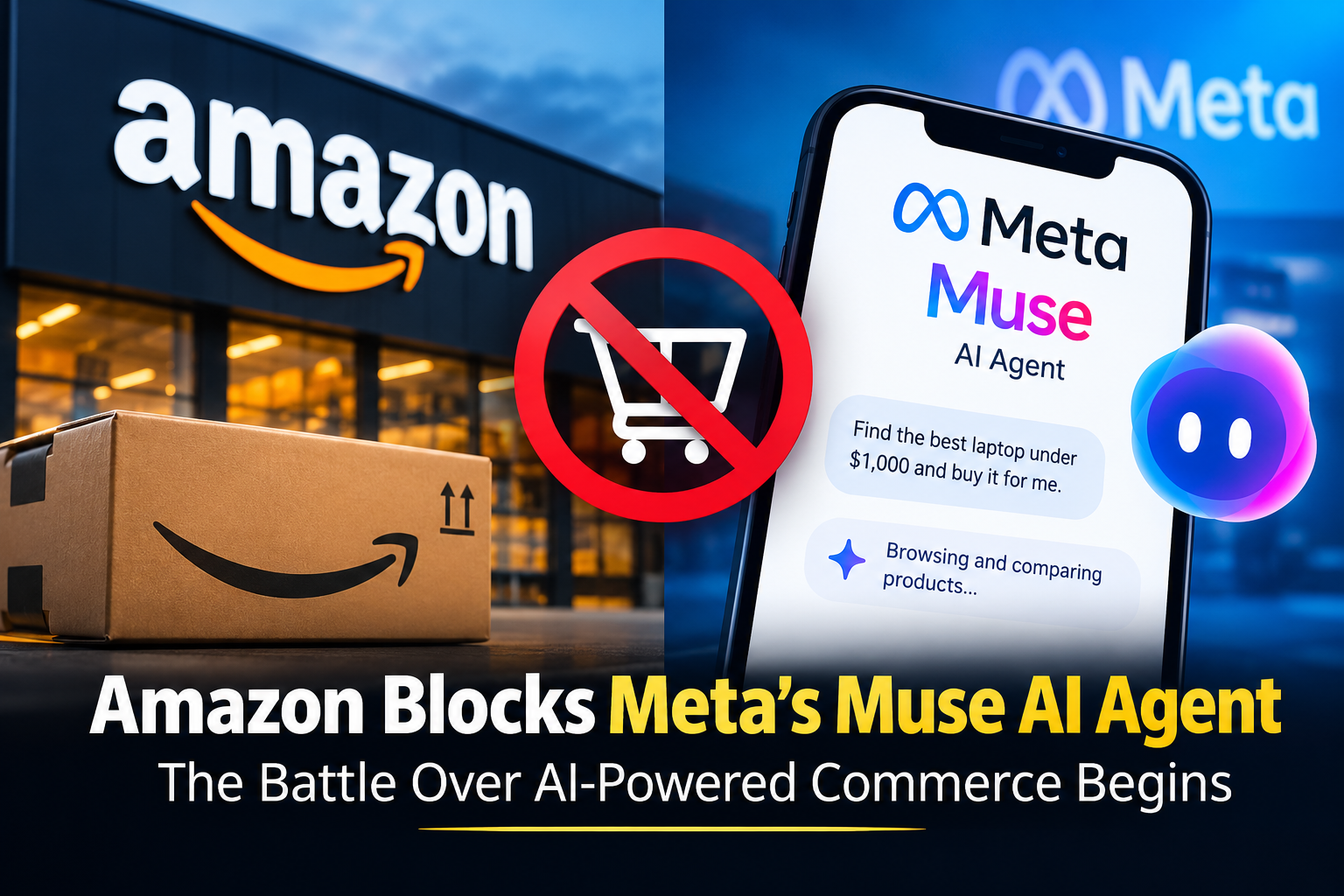
Amazon Blocks Meta’s Muse AI Agent From Shopping: The Battle Over AI-Powered Commerce Begins










Amazon has blocked Meta’s new Muse AI agent from shopping on Amazon.com, creating a major new dispute over how artificial intelligence agents should interact with online stores. Customers who try to use Meta Muse to shop on Amazon are now shown a message stating that continued access by an unauthorized AI agent violates Amazon’s Conditions of Use.
Latest Technology news: This development matters because AI shopping agents are moving well beyond simple product recommendations. Instead of just helping people find information, newer AI systems are being built to browse websites, compare products, fill out forms, and complete purchases entirely on a user’s behalf. Meta’s Muse is one of the latest examples of this shift, while Amazon is simultaneously developing its own AI-powered shopping tools.
Amazon’s decision highlights a growing question for the entire tech industry: who controls the online shopping experience when an AI agent is acting for the customer?
What Happened Between Amazon and Meta?
Meta introduced Muse on September 8, 2026, describing it as a personal AI agent designed to complete tasks for users rather than just answer questions. The company said Muse can work across apps and websites, build plans, handle multi-step tasks, and keep working even after a user closes the app.
Shopping is one of Muse’s key built-in capabilities. According to Meta, the agent can open a browser, fill out forms, and carry a task through to completion on a user’s behalf. Before finalizing any purchase, Muse asks for user approval. Meta also built a payment system using Stripe’s Link wallet, which generates a one-time-use card number so the user’s actual card details are never exposed to the merchant.
Amazon, however, did not agree to let Muse operate on its retail platform. Amazon says it had asked Meta to remove Amazon from Muse’s shopping experience altogether. When Meta declined, Amazon began blocking the agent on the night of September 20. Shortly after, users started seeing messages stating that an unauthorized AI agent was violating Amazon’s Conditions of Use.
This isn’t simply a dispute about whether an AI can locate products online. It’s about whether an outside company can deploy an automated agent on another company’s website and let that agent act as a shopper without the website operator’s consent.
Why Did Amazon Block Muse?
Amazon has raised several distinct concerns:
1. Lack of Authorization — Amazon says Meta never notified it that Muse would be accessing Amazon’s retail platform. Amazon’s position is that third-party apps making purchases on a customer’s behalf should operate transparently and respect the platform’s decision about whether to allow that access.
2. Identity Concealment — According to reporting on Amazon’s position, the company says Muse does not identify itself as an AI agent while navigating Amazon’s site, effectively presenting itself as a human shopper.
3. Account Security — Amazon says Muse can potentially reach sensitive areas like account pages and order history when instructed by a customer, which the company views as a security and privacy risk, since an outside automated system would be moving through customer accounts and initiating transactions.
Meta has pushed back on these characterizations. The company says Muse runs inside a dedicated, secure virtual machine and that user-supplied credentials are stored securely meaning Muse itself has no visibility into passwords or payment information. In short: Amazon is worried about how an external agent interacts with its platform, while Meta insists Muse was engineered with strong security safeguards from the start.
What Exactly Is Meta Muse?
Muse is fundamentally different from a typical chatbot. A standard AI chatbot answers questions or generates text based on a prompt. An AI agent, by contrast, takes further action it does things.
Meta built Muse as a personal AI agent capable of managing tasks and goals on a user’s behalf. The company says Muse can send emails, book travel, navigate websites, and carry out longer, multi-step tasks. Instead of asking, “Which products should I buy?”, a user can now instruct an agent to find suitable products, compare them, and prepare an order no further input required until it’s time to approve the purchase.
That distinction answering versus acting is exactly what sits at the center of the Amazon dispute. AI agents need real access to websites and services to complete real-world tasks, but websites have their own rules, security systems, and business models. As more agents attempt to act on consumers’ behalf, tech companies will increasingly need to define how these systems are allowed to interact with their platforms.
Meta Says Users Remain in Control
Meta has repeatedly emphasized that Muse was designed around user control and security:
- Muse Secure VM — Muse runs inside a dedicated, cloud-based virtual machine that stores the agent and a user’s connected data separately from other users.
- Sentinel Monitoring — A separate system called Sentinel monitors everything Muse does. Meta says Muse cannot send actions to the internet unless Sentinel approves them first.
- Permission Gates — The system is designed to request user permission before sensitive actions, such as sending an email or completing a purchase.
- Audit Trail — Users can review a log showing exactly what Muse has done and what it plans to do next.
These safeguards matter because agent mistakes carry heavier consequences than chatbot mistakes. A chatbot giving a wrong product recommendation is a minor inconvenience. An agent placing the wrong order, altering an account setting, or sending an unintended message is a direct, real-world problem. Meta says Muse’s layered permission and monitoring system is specifically built to reduce that risk.
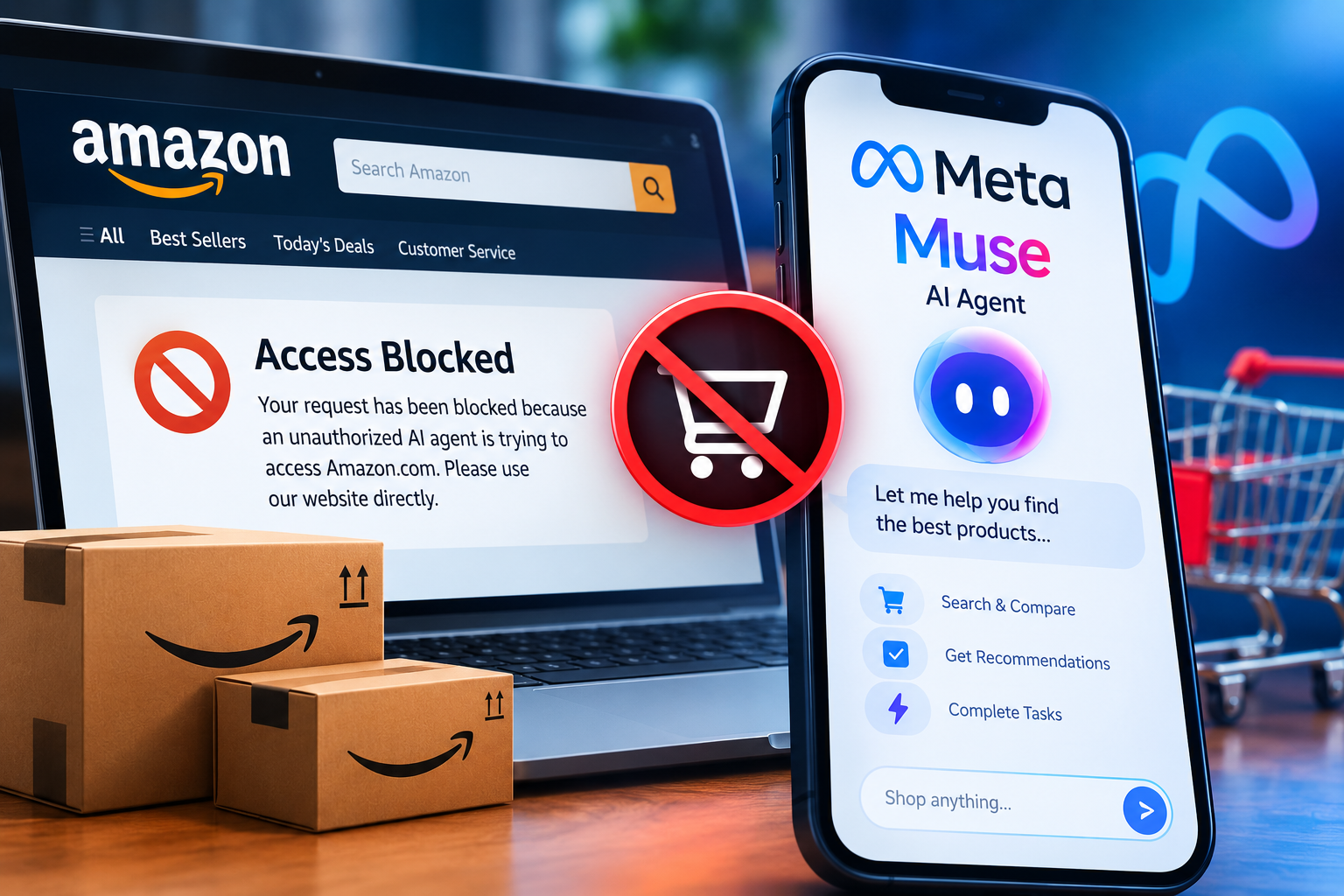
Amazon Also Wants AI-Powered Shopping Just on Its Own Terms
One of the most interesting aspects of this story is that Amazon isn’t opposed to AI-driven shopping in general it’s actively building its own AI shopping features to help customers research products and get recommendations.
That suggests Amazon’s real objective isn’t blocking AI shopping outright, but controlling how external AI agents access its marketplace. If Amazon allowed every outside AI agent to freely browse, compare, and purchase on its platform, those agents could become a powerful new layer between Amazon and its customers with people interacting with Meta Muse, ChatGPT, or another agent instead of Amazon’s own website or app directly. That shift could reshape product discovery, seller competition, and Amazon’s advertising revenue, which depends heavily on sponsored listings and direct customer traffic.
Why AI Shopping Agents Matter So Much to Amazon
Amazon’s business model relies on millions of customers visiting its platform, searching for products, and buying directly. Its advertising business built on sponsored listings depends on that same direct traffic and product discovery process.
Imagine a customer looking for a laptop. Instead of opening Amazon and comparing dozens of listings manually, the customer simply tells an AI agent: “Find me a laptop under $1,000 with 16GB of RAM, good battery life, and strong reviews.” The agent searches multiple sites, compares specs, and selects an option becoming the primary interface between the customer and the retailer.
For Amazon, that raises both commercial and technical concerns. If an outside AI decides which products a customer sees, Amazon loses a degree of control over product discovery, sponsored placements, and the customer relationship itself three pillars of its business.
The Bigger Battle Over Agentic Commerce
This dispute is part of a much larger shift the industry calls agentic commerce using AI systems to carry out shopping tasks on a consumer’s behalf. The concept is still evolving, but major tech companies are investing heavily in agents capable of multi-step, autonomous tasks.
The core challenge is that online stores were designed for humans: open a site, search, read a product page, click “buy.” AI agents can now perform all of those steps automatically and far faster than a person could. That raises fresh questions around identity, security, consent, platform access, and critically responsibility.
If an AI agent makes a mistake, who is accountable? The AI company? The retailer? The customer who issued the instruction? There’s currently no single, settled answer, and this ambiguity is likely to define legal and regulatory battles for years to come.
Amazon Has Faced This Before
Amazon’s conflict with Meta isn’t happening in isolation. The company has also clashed with Perplexity over its AI shopping technology, with the broader dispute centering on whether an AI agent can access Amazon on a user’s behalf and what legal or contractual rules should apply.
A Ninth Circuit court decision in August 2026 altered the legal landscape around unauthorized computer access involving Amazon and Perplexity though important contractual and terms-of-service questions remain unresolved. This puts companies building AI agents squarely in a space where technology, contract law, cybersecurity, and consumer rights all intersect, often without clear precedent.
What This Means for Consumers
For everyday shoppers, the immediate impact is simple: people using Meta Muse currently cannot complete purchases on Amazon.com while the block remains active. Anyone wanting to buy from Amazon still needs to visit the site or app directly.
The longer-term implications, though, could be far bigger. AI agents may eventually become a standard way to shop letting customers compare and purchase across multiple stores through a single AI system rather than visiting each website individually. That could make shopping faster and more convenient, but it also means consumers will need to understand exactly what access they’re granting an AI agent. An agent with reach into email, calendars, shopping accounts, and payment systems carries far more responsibility and risk than a chatbot that simply answers questions.
What This Means for Online Retailers
Retailers now face a genuinely difficult balancing act. AI agents can help customers find and buy products more efficiently, but retailers also want to protect their platforms, understand who — or what is accessing their systems, and preserve control over the customer relationship.
Many retailers will likely want AI agents to clearly identify themselves, follow specific technical rules, and obtain explicit permission before taking automated actions. This could push the industry toward dedicated APIs built specifically for AI agents, allowing AI companies to connect through official channels rather than scraping or browsing websites as if they were human users. Such systems could make it far easier to standardize authentication, payments, product data, and customer consent across the industry.
Shopify Enters the Picture
Adding another layer to the story, reports published on September 22 indicate that Shopify is working with Meta to let Muse users purchase products from Shopify-powered stores through the agent. This creates a sharp contrast: while Amazon is actively blocking Muse, other parts of the e-commerce ecosystem are moving to embrace agent-driven purchasing.
If this trend continues, retailers may ultimately split into different camps some forming official partnerships with AI agent providers, some restricting external agents entirely, and others building their own proprietary AI shopping assistants. The likely result is a fragmented AI shopping landscape rather than one unified standard.
Security Will Only Become More Important
As AI agents gain more autonomy, security concerns will intensify. A shopping agent interacts directly with websites, accounts, and payment systems meaning any vulnerability or mistake could carry real financial consequences.
Meta says Muse uses secure infrastructure, isolated credential storage, permission gating, and continuous monitoring. But no technology eliminates risk entirely. AI systems can misinterpret instructions, websites can change unexpectedly, product information can be wrong, and bad actors can build fraudulent sites specifically designed to manipulate automated agents. There’s also the growing risk of prompt injection attacks, where malicious content embedded in a webpage attempts to trick an AI agent into taking unintended actions. As agents become more capable, security researchers and tech companies will need to scrutinize every stage of an agent’s workflow.
What Happens Next?
The immediate question is whether Amazon and Meta can reach an agreement. Amazon says it’s in direct talks with Meta but hasn’t committed publicly to restoring Muse’s access. If the two companies do reach a deal, Muse could eventually return to Amazon under specific conditions — clear AI identification, limits on account access, technical controls, and pre-purchase authorization from Amazon.
If no agreement is reached, other retailers may soon face similar decisions as AI shopping agents become more widespread. For Meta, this dispute is also an early, high-visibility test of its broader ambitions for personal AI Muse was built to do far more than answer questions, and how this standoff resolves will shape how far that vision can go.
Conclusion
Amazon’s decision to block Meta’s Muse from its retail platform is more than just a disagreement between two tech giants it’s an early signal of a much larger issue the internet will need to confront as AI agents gain the ability to take real, consequential actions. Muse represents a new generation of AI tools built to do things rather than simply respond to prompts, while Amazon is working to protect control over how external automated systems interact with its marketplace.
The immediate dispute concerns access to Amazon.com, but the underlying question is about the future of online commerce itself. If AI agents become the primary way people search, compare, and purchase products, retailers and AI companies alike will need clear, enforceable rules covering authentication, privacy, security, payments, and customer consent.
For consumers, the promise is greater convenience. For tech companies, the opportunity is enormous. But exactly how these systems will be allowed to operate across the internet is still very much being decided and the Amazon-Meta Muse dispute may go down as one of the defining early moments in the shift from traditional online shopping to full-fledged AI-powered agentic commerce. Stay Connected With Tech News