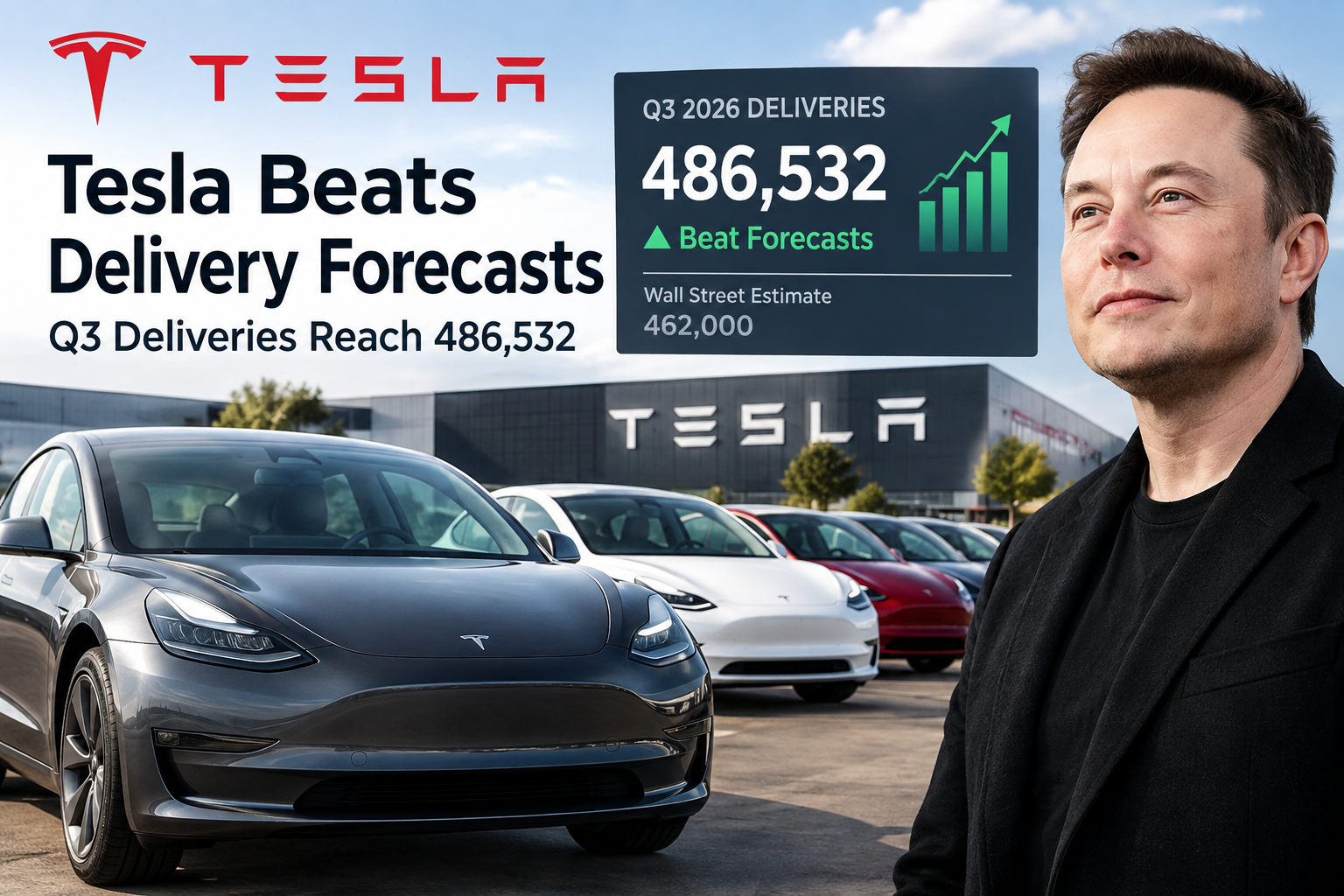
Tesla’s Auto Business Returns to Growth as Q3 Deliveries Beat Wall Street Forecasts
2
0










Latest Technology News: Tesla, the pioneer of the global electric vehicle (EV) revolution, has silenced critics and surpassed financial analysts’ expectations with its latest quarterly performance report. Following months of growing concerns over cooling global EV demand, macroeconomic headwinds, and fierce regional competition, Tesla’s third-quarter delivery numbers indicate a decisive turnaround for its core automotive operations.
By delivering significantly more vehicles than forecasted by Wall Street, Tesla has demonstrated the resilience of its brand power, supply chain efficiency, and global commercial strategy. This comprehensive deep dive explores how Tesla achieved these numbers, the regional markets that fueled the rebound, the booming growth of its energy storage segment, and what this momentum means for the future of the EV market.
The Numbers Breakdown: Q3 Deliveries vs. Expectations
Wall Street analysts and consensus forecasts had projected Tesla to deliver roughly 462,000 vehicles in the third quarter. When Tesla officially released its operational update, the actual figures outperformed those estimates across almost every key operational metric.
Official Q3 Performance Metrics
- Total Deliveries: 486,532 vehicles shipped globally, comfortably beating consensus estimates by more than 24,000 units.
- Total Production: 464,391 vehicles manufactured across Tesla’s global Gigafactories.
- Inventory Depletion: Deliveries outpaced total production by over 22,000 vehicles, indicating a healthy draw-down of existing inventory and strong immediate consumer demand.
These metrics confirm that despite temporary slowdowns earlier in the year, underlying consumer appetite for Tesla’s electric vehicles remains robust across key international territories.
Model Breakdown: Model 3 and Model Y Continue Dominance
Tesla’s mass-market offerings the Model 3 sedan and the Model Y crossover remained the undisputed growth engines driving the company’s delivery beat.
Mass-Market Leaders (Model 3 & Model Y)
Combined deliveries of the Model 3 and Model Y reached 478,237 units in Q3. Together, these two vehicles accounted for approximately 98% of Tesla’s total vehicle sales during the quarter.
The sustained popularity of these vehicles stems from a combination of factors:
Competitive Pricing: Strategic price adjustments and promotional financing packages in major markets.
Refreshed Designs: Recent aesthetic and feature upgrades (such as the updated Model 3 “Highland”) that refreshed customer interest.
Total Cost of Ownership: Lower ongoing fuel and maintenance costs relative to internal combustion engine (ICE) vehicles.
Premium & Niche Lineup (Model S, Model X, Cybertruck)
Tesla’s premium vehicles including the flagship Model S, the Model X SUV, and the futuristic Cybertruck collectively generated 8,295 deliveries. While these higher-tier models represent a smaller fraction of overall volume, they contribute higher profit margins and serve as key technological showcases for the Tesla brand.
Comparative Analysis: Sequential Growth and Year-Over-Year Trends
To fully understand Tesla’s trajectory, it is necessary to examine both quarter-over-quarter (sequential) trends and year-over-year (YoY) performance.
| Metric | Q3 Performance | Previous Period Comparison | Trend Analysis |
| Q3 Deliveries | 486,532 units | vs. Q2 (480,126 units) | +1.3% Sequential Increase |
| YoY Deliveries | 486,532 units | vs. Prior Year Q3 (497,099 units) | -2.0% Slight YoY Contraction |
| Q3 Production | 464,391 units | vs. Q3 Deliveries | +22,141 Inventory Reduction |
| Energy Storage | 13.7 GWh | vs. Prior Year Q3 (12.5 GWh) | +9.6% Year-over-Year Growth |
The 1.3% sequential rise from Q2 marks an important pivot point, signaling that the sales dip experienced in early months has plateaued and reversed course toward positive growth.
Key Regional Recovery Drivers: European and Asian Markets
Tesla’s global footprint allowed it to absorb localized economic pressures and leverage localized market recoveries during the third quarter.
European Market Rebound
After facing heightened competition and changes in government EV subsidies across Europe during the first half of the year, registration figures in September pointed to a sharp rebound:
France: Registration volume skyrocketed by 61.9% compared to September of the previous year.
Sweden: Sales rose by 38.4% YoY, reflecting renewed Nordic market adoption.
Spain: Registrations grew by 24.8% YoY, showcasing expanding Southern European momentum.
China Market Dynamics
In China the world’s largest and most competitive EV market Tesla maintained strong sales velocity despite aggressive pricing from domestic rivals like BYD, Nio, and XPeng. Attractive low-interest financing programs launched in Shanghai played a decisive role in locking in Q3 volume.
Tesla Energy: The Silent Growth Engine
While automotive headlines dominate media attention, Tesla’s Energy Storage business continued its exponential expansion, delivering higher margins and diversification away from vehicle manufacturing alone.
Q3 Energy Deployment Highlights
- Storage Deployed: 13.7 GWh of energy storage products deployed in Q3.
- Sequential Progress: Up from 13.5 GWh in Q2.
- Year-over-Year Expansion: A significant jump from 12.5 GWh deployed in the prior-year period.
Products like the utility-scale Megapack and residential Powerwall 3 are increasingly adopted by power grid operators, commercial enterprises, and homeowners globally, providing Tesla with a high-margin revenue stream that offsets automotive cyclicality.
Financial Impact and Wall Street Stock Reaction
The delivery beat provided an immediate boost to market sentiment, strengthening investor confidence ahead of Tesla’s full earnings report.
Stock Reaction: Tesla shares (TSLA) gained approximately 2% in initial trading following the publication of the delivery numbers.
Analyst Sentiment: Market watchers highlighted the significant draw-down in vehicle inventory as a clear indicator of strong operational cash flow.
Upcoming Earnings Date: Financial analysts and institutional investors are now turning their focus to October 21, when Tesla will officially publish its detailed Q3 financial results, gross margins, and operating income figures.
What Catalyzed Tesla’s Sales Rebound?
Tesla’s ability to turn around its auto business performance relies on several core strategic choices:
Flexible Pricing & Incentives: Instead of raw MSRP cuts, Tesla deployed targeted zero-percent or low-interest financing rates in key territories, significantly lowering monthly consumer payments.
Supercharger Network Dominance: The widespread reliability and rapid expansion of Tesla’s Supercharging network alongside the opening of chargers to non Tesla EVs remains an unbeatable selling point for prospective EV buyers.
Full Self-Driving (FSD) Progress: Continuous software iterations to Full Self-Driving (Supervised) software have increased customer satisfaction and boosted software add-on attachment rates.
Manufacturing Efficiency: Improved throughput and localization at Gigafactory Shanghai, Gigafactory Berlin, and Gigafactory Texas reduced logistics bottlenecks and accelerated order-to-delivery timelines.
Strategic Outlook and Future Challenges
Despite celebrating a strong third quarter, Tesla faces a complex global landscape heading into the next fiscal period.
Key Opportunities
- Full Self-Driving & Robotaxi Fleet: The long-term valuation of Tesla relies heavily on autonomous driving breakthroughs, AI computer clusters, and the deployment of purpose-built robotaxi fleets.
- Next-Generation Vehicle Platform: Development of a lower-cost, next-gen electric platform (expected around the $25,000 price point) remains vital to capturing mass market share in developing economies.
Ongoing Challenges
- Intense Domestic Competition in China: Local manufacturers continue to roll out feature-packed, budget-friendly EVs at rapid paces.
- Global Interest Rates: High interest rates in Western markets continue to make auto financing expensive for everyday consumers.
Summary and Key Takeaways
Tesla’s third-quarter delivery report delivers a clear message: the company’s core automotive business is back on a growth path. Delivering 486,532 vehicles in a challenging macroeconomic climate proves that demand for premium electric vehicles remains strong when paired with the right pricing and technology infrastructure.
With its automotive segment stabilized and its energy storage business breaking deployment records quarter after quarter, Tesla enters the final stretch of the year with strong momentum. All eyes now rest on the upcoming October 21 financial report to see how this delivery growth translates into bottom-line profitability.
Frequently Asked Questions (FAQs)
Q1: How many vehicles did Tesla deliver in Q3?
Answer: Tesla delivered 486,532 vehicles globally in the third quarter, comfortably surpassing Wall Street consensus estimates of approximately 462,000 units.
Q2: Did Tesla produce more vehicles than it delivered in Q3?
Answer: No, Tesla delivered more vehicles than it manufactured. Tesla produced 464,391 vehicles and delivered 486,532 vehicles, effectively reducing its overall vehicle inventory by over 22,000 units.
Q3: Which Tesla models were the most popular during Q3?
Answer: The Model 3 and Model Y were by far the most popular models, accounting for 478,237 deliveries, or roughly 98% of Tesla’s total third-quarter delivery volume.
Q4: How did Tesla perform in European markets during Q3?
Answer: Tesla experienced a noticeable sales recovery in Europe led by September registration spikes, including a 61.9% YoY increase in France, 38.4% in Sweden, and 24.8% in Spain.
Q5: How much energy storage did Tesla deploy in Q3?
Answer: Tesla deployed 13.7 GWh of energy storage products (including Megapack and Powerwall units) during Q3, up from 13.5 GWh in Q2 and 12.5 GWh in the same period last year.
Q6: When will Tesla release its full Q3 financial results?
Answer: Tesla is scheduled to publish its full Q3 financial report and host its quarterly earnings conference call on October 21.
Stay Connected With Tech News
tags: Electric Vehicles Elon Musk EV News Tesla Tesla 2026 Tesla EV Sales Tesla Model 3 Tesla Model Y Tesla Q3 Deliveries US Technology News