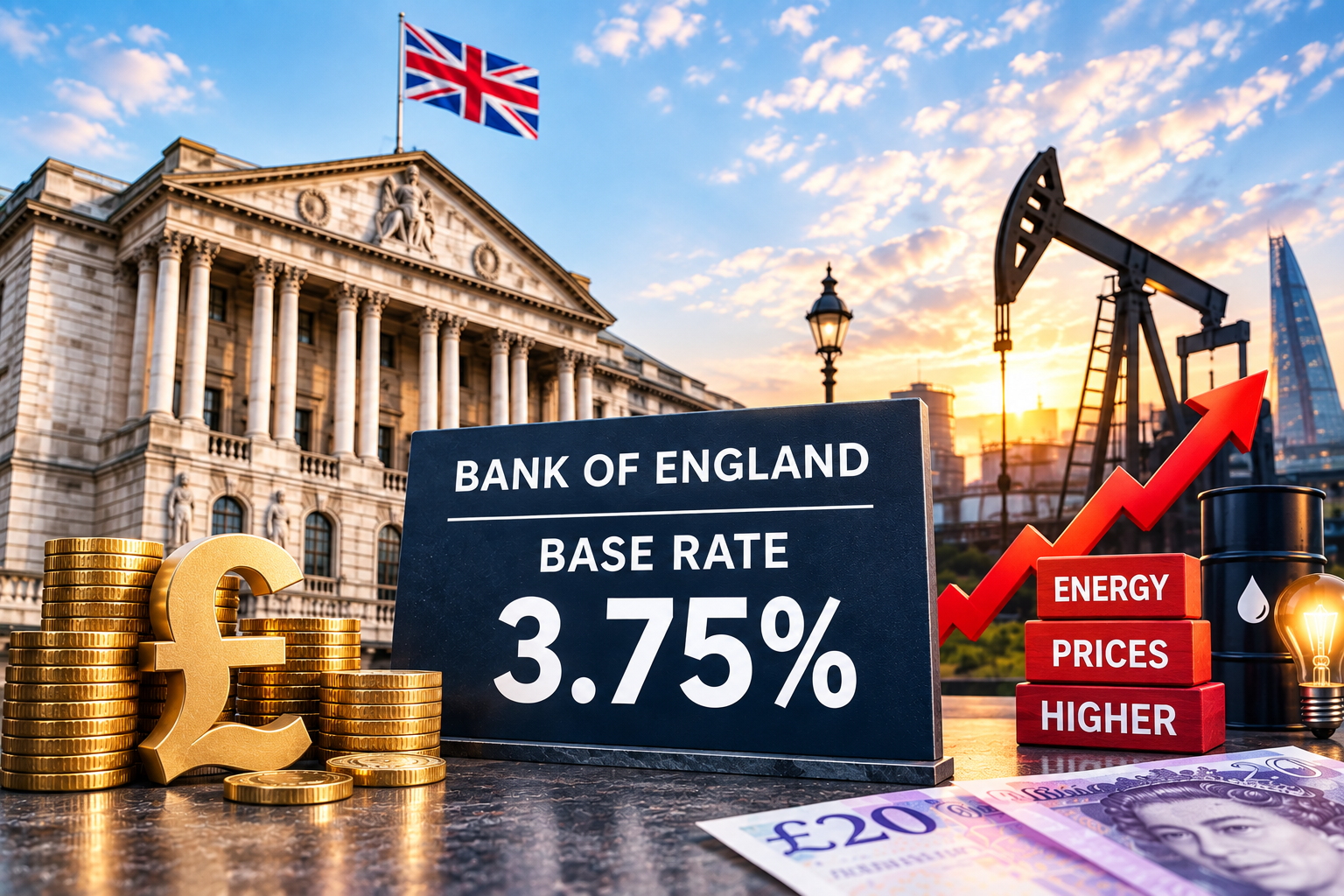
Bank of England Holds Rates at 3.75% as Energy Prices Raise Inflation Risks









The Bank of England has kept its benchmark interest rate unchanged at 3.75%, while warning that higher energy prices could create further inflationary pressure in the UK. The decision came on September 17 after the Bank’s Monetary Policy Committee (MPC) reviewed the latest inflation data, energy prices and wider economic conditions.
Latest Business News: The vote was 6–3. Six members supported keeping Bank Rate at 3.75%, while three members wanted to increase it by 0.25 percentage points to 4%. The decision means borrowing costs will remain unchanged for now. However, the split vote shows that policymakers continue to face uncertainty over the direction of inflation and interest rates.
What Actually Happened?
The Bank of England’s Monetary Policy Committee meets regularly to decide whether interest rates should rise, fall or remain unchanged. At the September meeting, six of the nine MPC members voted to maintain Bank Rate at 3.75%, while three members voted for a quarter-point increase to 4%.
The split shows that there are different views within the committee about how strongly monetary policy should respond to current inflation risks. However, the vote does not mean that the Bank has already decided what it will do at its next meeting. Future decisions will depend on new economic information, including inflation, energy prices, wages and economic activity.
Why Did the Bank Keep Rates at 3.75%?
The Bank of England aims to keep inflation at 2% over the medium term. UK inflation has moved above that target, with CPI inflation increasing from 2.9% in July to 3.1% in August 2026.
At the same time, higher energy prices have created another challenge for policymakers. An immediate increase in interest rates could put additional pressure on households and businesses that are already dealing with higher costs.
By keeping the rate unchanged, the majority of the MPC chose to assess how persistent the recent inflationary pressure will be before making another change to borrowing costs. The Bank will continue to monitor the data and assess whether higher energy prices are creating wider effects across the economy.
Higher Energy Prices Are a Major Inflation Risk
Energy prices are an important part of the current inflation discussion. Higher oil and gas prices can affect consumers and businesses in several ways, from fuel expenses to transportation and production costs.
When crude oil prices rise, petrol and diesel costs can increase. This can raise expenses for households and businesses that depend on road transport. Companies transporting products by road, air or sea can also face higher operating costs when energy prices increase. Those higher costs can eventually affect the prices of goods and services.
Manufacturers, retailers and other businesses use energy as part of their daily operations. Higher energy bills can reduce profit margins or lead some companies to increase prices. This process can contribute to cost-push inflation, which occurs when rising production or operating costs put upward pressure on consumer prices.
Why Energy Inflation Is Difficult for Central Banks
The Bank of England can influence borrowing costs in the UK, but it cannot directly control international oil or gas prices. This makes energy-related inflation particularly complicated for monetary policymakers.
If energy prices rise because of global supply problems, raising interest rates does not directly make oil cheaper. Instead, higher interest rates work by reducing demand within the domestic economy. For example, higher borrowing costs can encourage households to spend less and businesses to reduce or delay some investment.
The challenge for the Bank is therefore to determine whether the energy shock is temporary or whether it could lead to broader and more persistent inflation.
What Does the Decision Mean for UK Households?
For households, the Bank Rate can influence the cost of borrowing and the return available on some savings products. People with variable-rate mortgages may see changes in their borrowing costs when lenders adjust rates.
People who are refinancing or taking out a new mortgage also pay close attention to interest-rate expectations. Personal loans and other forms of borrowing can become more expensive when interest rates remain elevated.
Higher interest rates can provide better returns on some savings accounts and fixed-term deposits. The effect is therefore different from household to household. A person with significant borrowing may be more concerned about higher rates, while someone with substantial savings may benefit from higher deposit rates.
The Bank’s decision to hold at 3.75% means there is no immediate change in the official Bank Rate.
What Does It Mean for UK Businesses?
Businesses are also watching the interest rate decision closely. Companies often use borrowing to finance investment, expansion, equipment and working capital. When interest rates remain high, financing can become more expensive.
At the same time, businesses may be facing higher energy and transportation costs. This combination can create difficult decisions for companies. A business may choose to absorb higher costs, which can reduce its profit margin. Alternatively, it may increase prices to cover some of those costs.
If higher costs lead to wider price increases across the economy, inflation could remain above the Bank’s target for longer. This is one reason policymakers are watching business pricing behaviour closely.
UK Inflation Has Increased
The latest inflation figures are an important part of the Bank’s decision. UK CPI inflation reached 3.1% in August 2026, compared with 2.9% in July. That puts inflation more than one percentage point above the Bank of England’s 2% target.
However, one monthly inflation figure does not determine the future direction of interest rates. The MPC will look at a wider range of information to understand whether inflation is becoming persistent or whether the latest increase is mainly connected to temporary factors.
Energy prices are particularly important because changes in fuel and other energy costs can affect both household expenses and business costs.
What the 6–3 Vote Tells Us
The September vote was not unanimous. Six members supported holding Bank Rate at 3.75%, while three wanted to increase it to 4%.
This difference of opinion shows that the MPC is assessing significant inflation risks while also considering the wider economic impact of higher borrowing costs. The three votes for an increase do not guarantee that the Bank will raise rates at its next meeting.
Similarly, the six votes for a hold do not guarantee that rates will remain at 3.75% for the rest of the year. The committee will make each decision based on the economic information available at the time.
What Is the Bank Watching Before November?
The next scheduled Bank of England interest rate decision is November 5, 2026. Before that meeting, policymakers are expected to assess several economic indicators.
These include UK inflation, energy and fuel prices, wage growth, consumer spending, economic growth, business pricing, labour market conditions, global economic developments and geopolitical risks.
Changes in these areas could influence the MPC’s assessment of inflation and the appropriate level of interest rates.
Could Interest Rates Rise Again?
A future rate increase remains possible, particularly if inflation stays elevated and energy prices continue to create persistent pressure. However, the Bank has not committed to a specific future rate increase.
The September decision should therefore be understood as a decision for the current meeting rather than a fixed plan for November. If inflationary pressure becomes more persistent, policymakers may consider whether further monetary tightening is necessary. If price pressures ease, the committee could reach a different assessment.
The direction of interest rates will depend on how the economic data develops.
What Could Happen If Energy Prices Remain High?
If energy prices remain elevated for an extended period, the impact could spread beyond fuel and utility bills. Businesses may face higher production and transportation costs, while households could have less money available for other spending after paying higher energy and fuel bills.
If businesses respond to higher costs by increasing prices, inflation could remain higher for longer. The Bank of England therefore needs to determine whether higher energy costs are producing temporary price increases or contributing to broader inflation.
This distinction will be important for future monetary policy decisions.
Impact on Financial Markets
Bank of England decisions also matter to financial markets. Interest rate expectations can influence government bond yields, mortgage pricing, corporate borrowing costs and the value of sterling.
Investors often examine not only the interest rate decision itself but also the voting pattern and the Bank’s assessment of the economic outlook. The 6 3 vote provides information about the different views within the MPC.
However, financial markets can change their expectations quickly when new inflation, employment or energy-price data becomes available.
The Bigger Picture
The September 17 decision highlights the difficult position facing the Bank of England. Inflation is above the Bank’s 2% target, while higher energy prices have added another source of uncertainty.
At the same time, higher interest rates can increase borrowing costs for households and businesses. The Bank therefore has to consider both inflation risks and the wider economic impact of monetary policy.
The current decision gives policymakers more time to assess whether recent inflationary pressure will continue. Energy prices will remain an important factor in that assessment.
If the energy shock fades, some of the pressure on inflation could ease. If energy prices remain high and begin contributing to broader price and wage increases, the Bank may need to reconsider its policy position.
Frequently Asked Questions
What is the Bank of England interest rate right now?
The Bank of England has kept its Bank Rate at 3.75% following its September 17, 2026 decision.
Why did the Bank of England not raise rates?
The MPC voted 6 3 to keep Bank Rate unchanged while continuing to assess inflation, energy prices and wider economic conditions.
Could the Bank of England raise interest rates again?
Yes, a future increase remains possible. However, the Bank has not committed to a specific rate increase. Future decisions will depend on incoming economic data.
What is UK inflation currently?
UK CPI inflation reached 3.1% in August 2026, up from 2.9% in July.
What is the Bank of England’s inflation target?
The Bank of England’s inflation target is 2% over the medium term.
Why are energy prices important for UK inflation?
Higher energy prices can increase fuel, transportation and business operating costs. These higher costs can put upward pressure on prices across the economy.
When is the next Bank of England interest rate decision?
The next scheduled Monetary Policy Committee decision is November 5, 2026.
Final Thoughts
The Bank of England has kept interest rates at 3.75%, but the September decision shows that inflation remains an important concern. The 6–3 vote also demonstrates that policymakers have different views about the appropriate response to current inflationary pressure.
For households and businesses, the immediate result is stability in the official Bank Rate. However, the outlook remains dependent on economic data.
Energy prices, inflation, wages and wider economic conditions will all be important before the Bank makes its next decision. For now, the Bank has chosen to hold rates and continue monitoring the situation. The November meeting will provide another important update on how policymakers assess the UK’s inflation and interest-rate outlook. Stay Connected With Tech News