Global Stocks Under Pressure as Oil Nears $100 and Inflation Risks Rise










September 7, 2026
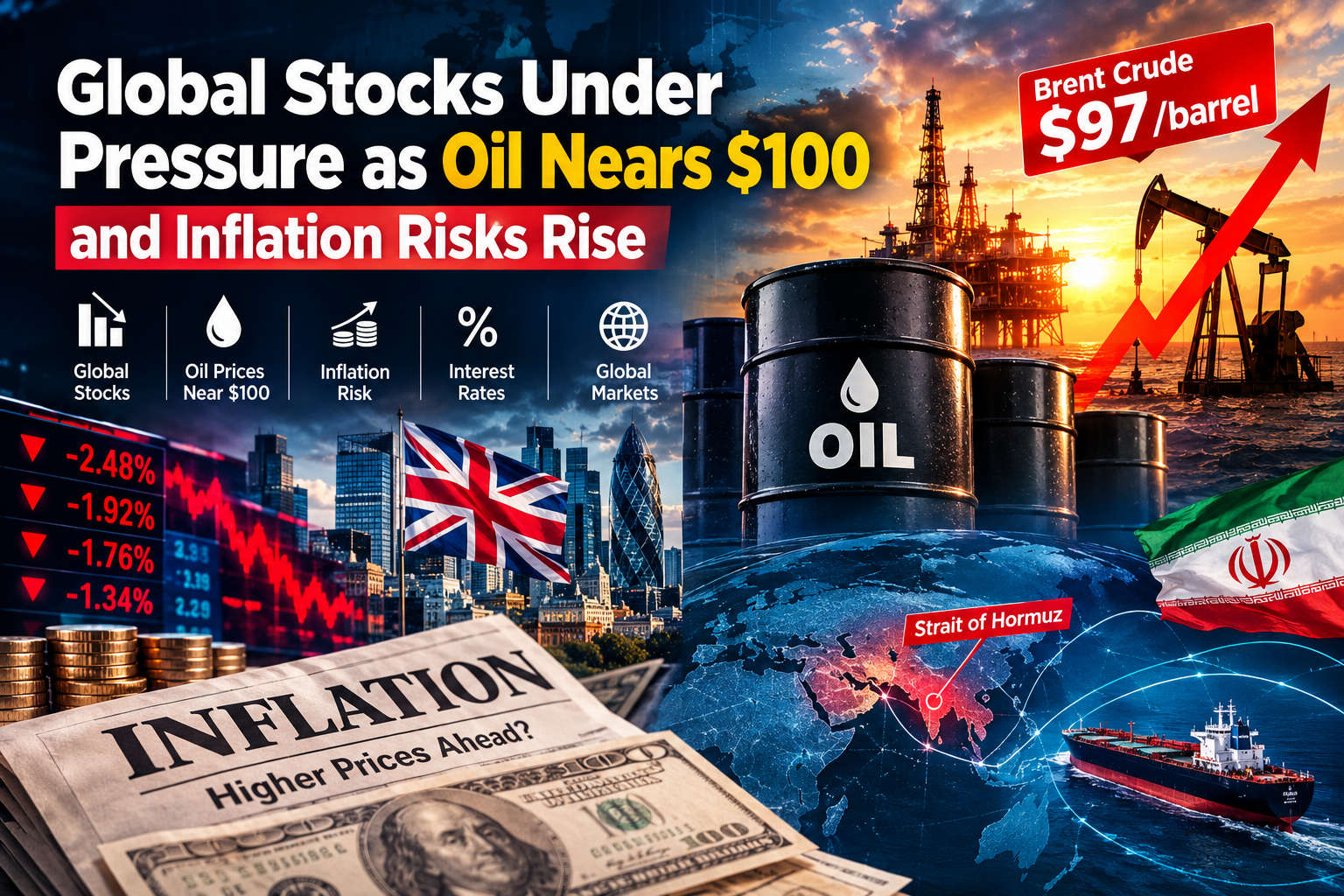
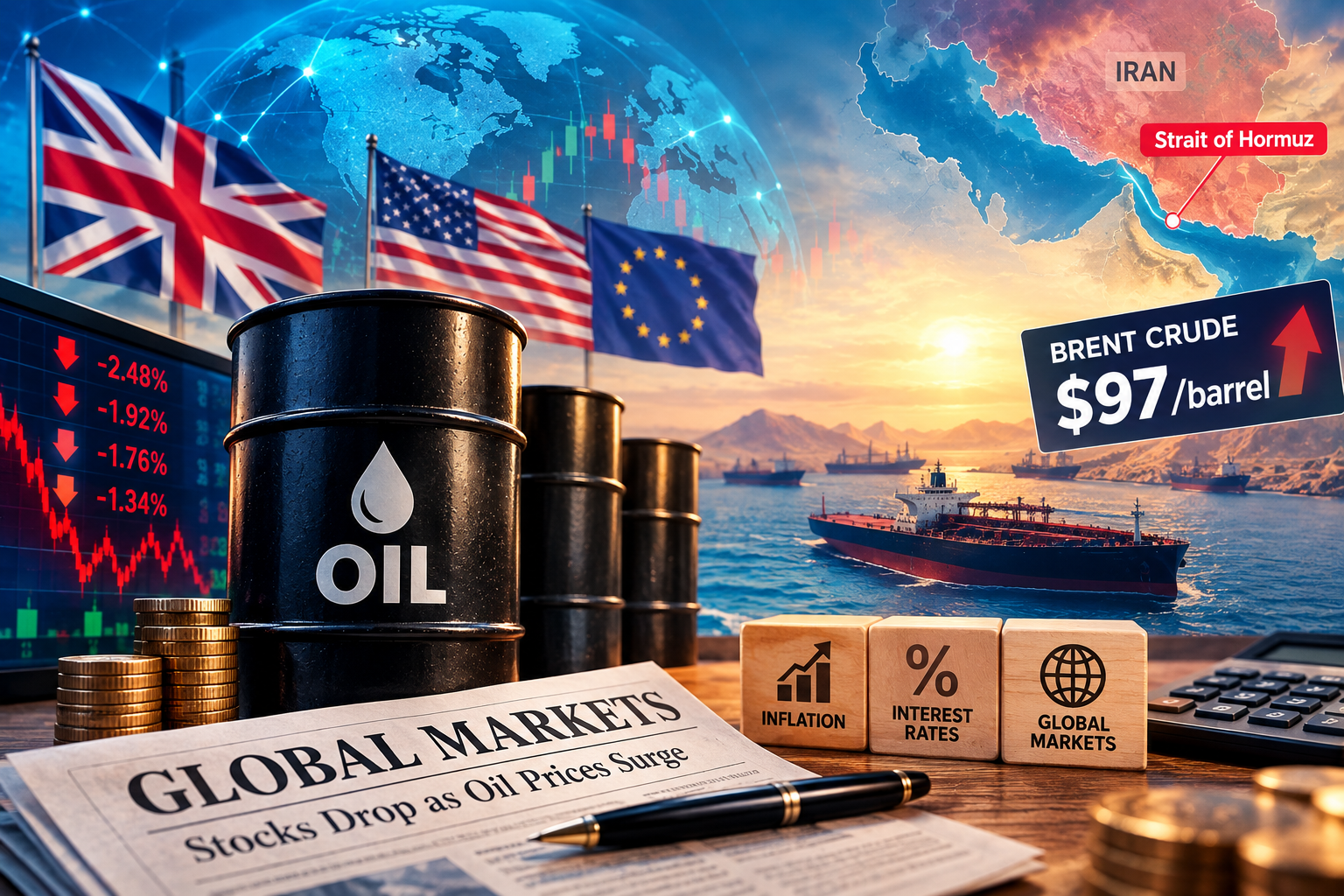
Latest Business News: Global stocks started the week under pressure as rising oil prices, renewed Middle East tensions and growing inflation concerns made investors more cautious. Brent crude moved close to $97 a barrel, while higher energy costs increased expectations that major central banks may need to keep interest rates higher for longer.
The latest market move is important for both the UK and US because expensive oil does not only affect fuel prices. It can also increase transportation costs, business expenses and consumer prices. That creates a difficult environment for central banks, especially when investors are already watching interest rates closely.
London’s FTSE 100 slipped around 0.1% to 10,824.74 points on Monday, although gains in energy companies helped limit the decline. The FTSE 250 also fell around 0.1%.
At the same time, investors are watching developments around the Strait of Hormuz, where shipping activity has fallen sharply following recent attacks involving US and Iranian forces. Reuters reported that an average of only 10 commodity ships a day crossed the strait over the previous 10 days, the lowest level since May.
Why Global Stocks Are Under Pressure Today
The latest market weakness is being driven by several connected risks rather than one single event.
The biggest concern is oil.
When crude prices rise rapidly, investors start thinking about what higher energy costs could mean for inflation. If inflation remains elevated, central banks have less room to reduce interest rates and may even consider additional increases.
That can put pressure on stock valuations because higher interest rates increase borrowing costs and can reduce the attractiveness of riskier assets.
This is why the current market story is broader than simply saying that stocks are falling because of tensions in the Middle East.
The real concern is the chain reaction:
Geopolitical tension → oil supply concerns → higher energy prices → inflation pressure → higher interest-rate expectations → pressure on stocks.
That chain is now becoming an important theme for global markets.
Oil Prices Move Toward $100
Brent crude has become one of the most important numbers for investors this week.
Reuters reported that Brent was around $97 a barrel, with the benchmark roughly 35% above its late-February level. Diesel prices have also reached record highs, creating an additional inflation concern for businesses and consumers.
Higher diesel prices matter because diesel is heavily used in transportation, logistics, agriculture and industrial activity.
That means an increase in diesel costs can eventually appear in the prices of many everyday products.
For example, a retailer may pay more to move goods from a warehouse to stores. A manufacturer may face higher delivery and operating expenses. Farmers can also face increased costs for machinery and transportation.
Those costs can eventually be passed to consumers.
This is why investors are not only watching the price of crude oil. They are also watching whether higher energy prices remain elevated for long enough to create broader inflation.
Strait of Hormuz Becomes a Major Market Risk
The Strait of Hormuz is another major factor behind the oil market’s current sensitivity.
The waterway is one of the world’s most important energy shipping routes. Recent military activity involving the United States and Iran has increased concerns about the movement of oil and other commodities through the region.
Reuters reported that Iran plans to announce a new restricted zone in the Gulf in the coming days, along with details of a new shipping corridor through the Strait of Hormuz.
At the same time, the UAE is working on alternative routes for energy exports and trade, highlighting how seriously regional governments are treating the disruption risk.
The key issue for markets is not necessarily that oil supplies have completely stopped.
It is the uncertainty.
If shipping companies, insurers and energy traders believe the risk of disruption is increasing, oil prices can rise even before a large physical shortage appears.
That risk premium can remain in the market as long as investors believe the geopolitical situation could deteriorate further.
UK Stocks Feel the Pressure
The UK market provides an interesting example of how higher oil prices can affect different parts of an index in different ways.
The FTSE 100 declined around 0.1% on September 7, but energy stocks gained as higher crude prices improved the outlook for oil producers.
This means rising oil prices are not automatically negative for every UK-listed company.
Energy companies can benefit from stronger commodity prices, while industries that depend heavily on fuel can face higher costs.
Airlines, transport companies, manufacturers and some retailers may be more exposed to higher energy expenses.
For the wider UK economy, however, prolonged energy inflation could become a concern.
If fuel and transportation costs remain high, businesses may raise prices. Consumers could then have less money available for discretionary spending.
That creates a difficult balance for policymakers.
Why US Investors Are Watching Inflation
US markets are also focused on inflation and interest rates.
The latest US jobs data added another layer to the market debate. Employers added 162,000 jobs in August, well above economists’ expectations of 56,000. The unemployment rate remained at 4.1%.
The strong jobs report increased expectations that the Federal Reserve could raise interest rates at its September meeting.
Reuters reported that markets were pricing roughly a 57% probability of a September rate increase, while investors were also preparing for the US inflation report due later this week.
This creates an unusual situation.
Normally, strong employment can be positive for stocks because it suggests the economy is healthy.
But when inflation is already a concern, strong employment can also make investors worry that the Federal Reserve will keep monetary policy tighter.
That is why good economic news can sometimes become bad news for markets.
The Federal Reserve Has a Difficult Decision
The Fed now has to balance two competing risks.
On one side, the US economy is showing signs of resilience, particularly through the labor market.
On the other side, higher energy prices could make inflation harder to control.
If oil prices remain elevated, the Fed may become more cautious about lowering rates.
The upcoming US inflation data therefore becomes especially important.
A weaker-than-expected inflation reading could reduce some pressure on the Fed.
A stronger reading, particularly if energy-related costs begin affecting broader prices, could strengthen expectations for higher rates.
Investors will therefore be watching both the headline inflation figure and signs of underlying price pressure.
Europe Faces an Inflation and Rate-Hike Problem
Europe is facing a similar challenge.
Euro zone inflation moved above 3% in August, with higher energy prices playing an important role. The European Central Bank is widely expected to raise its policy rate by 25 basis points to 2.5% at its September meeting.
The bigger question is what happens after September.
Some economists expect the ECB’s next move to be the final hike of the current tightening cycle. However, Deutsche Bank has changed its outlook and now expects another 25-basis-point increase in December if energy-related inflation remains persistent.
This shows why oil prices have become so important for European markets.
If energy prices fall, inflation pressure could ease and central banks could eventually become less aggressive.
If energy prices remain high, policymakers may have to keep rates higher despite the risk of weaker economic growth.
What Does This Mean for Technology Stocks?
Technology stocks are particularly sensitive to interest-rate expectations because many growth companies are valued partly on future earnings.
When bond yields rise, investors can become less willing to pay very high valuations for companies whose biggest profits may come years into the future.
That does not mean the technology sector is suddenly in a crisis.
It means the market becomes more selective.
Companies with strong cash flow, solid earnings and sustainable growth can remain attractive, while expensive stocks with weak current profits can face greater pressure.
This is especially important for the AI sector, where investors have already been debating high valuations and massive infrastructure spending.
Businesses Could Feel the Impact Before Consumers
One of the most important parts of the current market story is the effect on businesses.
Higher oil prices can increase:
- Transportation costs
- Manufacturing expenses
- Shipping costs
- Agricultural expenses
- Airline fuel bills
- Delivery costs
- Energy bills
- Production costs
Businesses have two choices when these costs rise.
They can absorb the additional expense and accept lower profit margins, or they can pass some of the increase to customers.
If many businesses choose the second option, inflation can become more persistent.
That is the scenario investors are trying to avoid.
What Could Happen If Oil Reaches $100?
A move above $100 would be psychologically important, but the number itself would not automatically cause a market crash.
What matters more is how long oil stays above that level.
A short-term move toward $100 could be manageable if geopolitical tensions ease quickly.
A prolonged period near or above $100 would be more concerning because businesses and consumers would have more time to feel the impact.
It could also keep inflation expectations elevated and encourage central banks to maintain restrictive policies.
In my view, the duration of the oil shock is therefore more important than the headline $100 level itself.
What Investors Should Watch This Week
Markets are likely to remain highly sensitive to several developments.
1. Brent crude
If Brent continues moving toward or above $100, inflation concerns could increase.
2. Strait of Hormuz
Any major change in shipping activity or military tensions could quickly affect energy markets.
3. US inflation data
The US CPI report is due on September 11 and could influence expectations for the Federal Reserve’s September decision.
4. Federal Reserve expectations
Investors will continue watching whether markets price a September rate hike more aggressively.
5. ECB decision
The ECB is expected to raise rates to 2.5% on September 10, making its guidance on future hikes particularly important.
6. FTSE 100
UK investors will be watching whether energy stocks can continue supporting the FTSE 100 while higher rates and inflation pressure weigh on other sectors.
Our View: The Market Risk Has Changed
The biggest change in the market is that investors are no longer looking at the Middle East conflict only as a geopolitical story.
It has become an economic story.
Oil prices, shipping costs, inflation, interest rates and stock valuations are now connected.
That makes the situation more complicated than the market selloff seen earlier in September.
Our view is that investors should focus less on one day’s stock-market movement and more on whether the oil shock continues.
If oil prices stabilize and shipping conditions improve, some of the inflation premium could disappear quickly.
But if geopolitical tensions continue and energy prices remain elevated, central banks may have to maintain tighter monetary policy for longer.
That would create a more challenging environment for stocks, especially highly valued growth companies.
Global Markets Enter a More Uncertain Week
The latest market moves show how quickly geopolitical developments can spread into financial markets.
Rising oil prices are affecting inflation expectations. Inflation expectations are affecting interest-rate forecasts. Rate forecasts are affecting bonds and stocks.
The UK is watching energy prices and the FTSE 100. US investors are focused on the Federal Reserve and upcoming inflation data. European markets are preparing for an ECB rate hike while dealing with higher energy costs.
For now, there is no clear evidence that the latest market weakness represents the beginning of a major stock-market crash.
Instead, investors are dealing with a period of unusually high uncertainty.
The key question is simple: will the oil shock fade, or will higher energy prices become a longer-lasting inflation problem?
That answer could determine the direction of global markets over the next several weeks.
Final Thoughts
Global stocks are under pressure because several risks are arriving at the same time. Oil is approaching $100, Middle East tensions remain high, shipping through the Strait of Hormuz is under pressure and central banks are becoming more concerned about inflation.
For UK and US investors, the next major signals will come from oil prices, US inflation data, Federal Reserve expectations and the ECB’s policy decision.
The situation can change quickly. If geopolitical tensions ease, markets could stabilize. If energy disruption continues, inflation and interest-rate fears could become stronger.
For now, investors have one number firmly in focus: the price of oil. Stay Connected With Tech News