Nasdaq Hits Record High as AI Rally Pushes AMD Past $1 Trillion










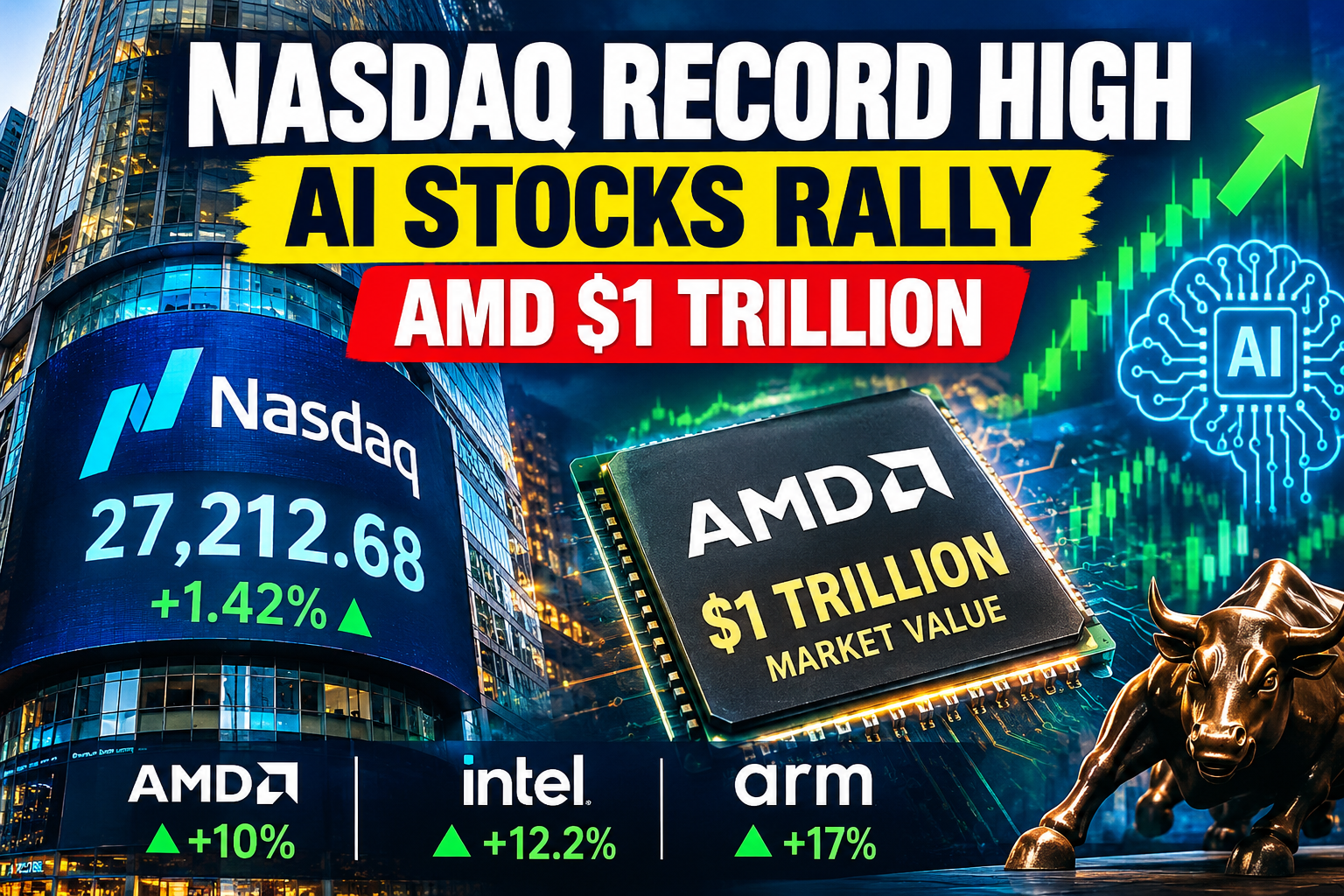
Latest Business News : The US stock market is back in the spotlight as technology and artificial intelligence stocks lead a powerful market rally. The Nasdaq Composite hit a record closing high on Monday, September 21, while semiconductor stocks posted some of their strongest gains in recent trading.
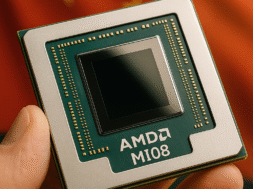
At the center of the rally was Advanced Micro Devices (AMD). The chipmaker crossed a $1 trillion market value for the first time as investors increased their focus on artificial intelligence computing and semiconductor demand.
The market move continued into Tuesday, September 22. The Nasdaq Composite touched an intraday record of 27,212.68, surpassing its previous intraday record from June. Reuters reported that technology stocks regained momentum as AI demand remained strong and oil prices declined.
The latest market action shows how closely US stocks are now connected to the growth of artificial intelligence, semiconductor technology and data-center investment.
Nasdaq Sets a Record Closing High
On Monday, September 21, the Nasdaq Composite closed at 27,122.09, gaining 599.55 points, or about 2.3%.
The index moved above its previous closing record of 27,093.90 set in June. The Nasdaq led the major US indexes during the session, helped by strong gains in semiconductor and technology companies.
The S&P 500 rose 1.5% to 7,764.70, while the Dow Jones Industrial Average gained about 0.7% to 52,048.83. The Russell 2000 also moved higher.
The Nasdaq’s performance was particularly significant because technology stocks had faced pressure earlier in the year. Concerns about high valuations, interest rates and the enormous cost of AI infrastructure had created uncertainty around the technology sector.
Monday’s rally showed renewed investor confidence in AI-related businesses and semiconductor companies.
Nasdaq Reaches Another Intraday Record on September 22
The market story did not stop with Monday’s closing record.
On Tuesday, September 22, the Nasdaq Composite reached an intraday record of 27,212.68. This was higher than the previous intraday record of 27,190.21 set on June 1.
Reuters reported that the technology-heavy index was around 0.3% higher in early trading as technology stocks recovered and falling oil prices supported broader risk appetite.
This distinction between a closing record and an intraday record is important.
Monday produced the new record close at 27,122.09, while Tuesday produced a new intraday high above 27,200.
The two sessions together show how quickly technology stocks have regained momentum.
AMD Crosses the $1 Trillion Market Value
One of the biggest individual stories behind the rally is AMD.
AMD shares surged during Monday’s session and crossed the $1 trillion market capitalization level for the first time.
Reuters reported that AMD shares rose about 9.6% to a record $613.31 during the session. The move pushed the company into the group of US semiconductor companies valued above $1 trillion.
Market capitalization represents the total market value of a company’s outstanding shares. Therefore, AMD reaching a $1 trillion market value does not mean the company has $1 trillion in cash or revenue.
Instead, it means investors collectively valued the company’s outstanding shares at more than $1 trillion based on its market price.
The milestone is significant because AMD has become an important competitor in the growing market for AI and data-center computing.
Why AMD Is Important to the AI Market
Artificial intelligence requires enormous amounts of computing power.
Companies developing AI models and services need powerful processors, accelerators and data-center infrastructure. This has created a rapidly growing market for semiconductor companies.
AMD supplies processors and AI accelerators used in data centers and other computing systems.
The company has been expanding its position in AI computing while competing with some of the biggest names in the semiconductor industry.
Its latest market-value milestone shows how investors are increasingly valuing companies that provide the hardware needed to support AI systems.
The rise is also supported by AMD’s recent business performance.
AMD Reports Strong Second-Quarter Revenue
AMD’s second-quarter 2026 results provide important context for the stock-market rally.
According to AMD’s official financial results, the company generated $11.536 billion in revenue during the second quarter, representing a 50% increase from the same quarter a year earlier.
The company’s data-center business was particularly strong.
AMD reported $6.7 billion in Data Center revenue, an increase of 107% year over year. The segment was driven by demand for AMD EPYC processors and Instinct GPUs.
Data Center revenue represented about 58% of AMD’s total quarterly revenue.
These numbers help explain why investors are paying close attention to AMD as AI infrastructure spending continues.
The company itself said AI is driving a significant expansion in demand for computing across its markets.
Semiconductor Stocks Rally Across the Market
AMD was not the only semiconductor company to gain.
Reuters reported that Intel surged about 12.2%, while Arm Holdings gained 17% during Monday’s session. The Philadelphia Semiconductor Index also climbed approximately 4.3%.
The broad semiconductor rally is important because it shows that investor interest was not limited to AMD.
The AI infrastructure market involves many different types of hardware.
Data centers require processors, GPUs, memory, networking equipment and other semiconductor products. As technology companies expand their AI infrastructure, demand can spread across multiple parts of the semiconductor supply chain.
This is one reason semiconductor stocks have become such an important part of the AI investment story.
Nvidia and Other Technology Stocks Also Gain
The rally extended beyond AMD, Intel and Arm.
Several large technology companies also gained during Monday’s session as investors returned to AI-related stocks.
The broader technology rally helped the Nasdaq outperform the other major US indexes.
The market’s response shows that investors continue to view artificial intelligence as an important source of future technology growth.
However, the latest gains should not automatically be interpreted as proof that every AI company will benefit equally.
Different companies have different products, customers, costs and competitive positions.
Why AI Demand Is Driving Semiconductor Interest
The AI industry has moved beyond the early stage of simply developing large AI models.
Companies are now working to put AI tools into everyday products and business systems.
AI assistants, enterprise software, cloud services and automated applications all require computing power.
This creates two major types of demand.
The first is AI training, where powerful computers are used to develop and train models.
The second is AI inference, where trained models process requests and generate results for users.
As AI applications become more widely used, inference workloads can become increasingly important.
This helps explain why investors are watching companies such as AMD and other semiconductor suppliers closely.
Falling Oil Prices Also Supported the Rally
Technology stocks were also helped by changes in the oil and bond markets.
On Monday, oil prices declined and the US 10-year Treasury yield moved lower. AP reported that Brent crude moved back toward $100 per barrel while the 10-year Treasury yield fell to around 4.95%.
Lower oil prices can reduce some inflation pressure because energy costs affect transportation, manufacturing and other parts of the economy.
Bond yields are also important for technology stocks.
When Treasury yields rise sharply, high-growth technology companies can face additional valuation pressure. When yields retreat, some of that pressure can ease.
The latest market move therefore involved several factors rather than AI alone.
AI optimism, semiconductor gains, lower oil prices and retreating Treasury yields all contributed to a more supportive environment for technology stocks.
Oil Prices Remain Important on September 22
Oil prices remained an important market factor on Tuesday.
Reuters reported that Brent crude fell as much as 3% before recovering to around $97.60 per barrel, while the US 10-year Treasury yield fell by about three basis points to 4.93%.
The decline in oil prices was linked to signs that oil supply concerns could ease.
These developments helped support investor appetite for risk assets, including technology stocks.
However, oil prices can change quickly because they are affected by geopolitical developments, supply conditions and expectations about global demand.
The AI Rally Still Faces Questions
The latest Nasdaq record is significant, but it does not remove the risks facing the technology sector.
One major question is whether the enormous amount of money being invested in AI infrastructure will eventually produce enough revenue and profit to justify the spending.
Technology companies are spending heavily on data centers, chips, networking equipment and AI development.
These investments can create strong demand for semiconductor companies.
But businesses also need customers to pay for AI services and products.
This means future earnings and revenue growth will remain important.
Investors will continue watching whether AI spending produces measurable business results.
Why AMD’s $1 Trillion Milestone Matters
AMD’s milestone is important because it shows how much the semiconductor industry has changed during the AI boom.
A few years ago, much of the public AI discussion focused on software and AI models.
Today, the infrastructure behind AI has become equally important.
Companies need powerful chips to train models and run AI applications.
They also need data centers with large amounts of computing capacity.
AMD’s growing data-center business puts it directly inside this expanding infrastructure market.
Its second-quarter results show that this is not only an investment theme. The company is already reporting substantial growth in its data-center business.
What Investors Will Watch Next
The next stage of the market story will depend on several factors.
AI revenue growth will remain important because investors want evidence that AI spending is producing sustainable business results.
Semiconductor earnings will also receive significant attention. Results and guidance from AMD, Nvidia, Intel, Micron and other companies can influence the entire sector.
Interest rates remain another major factor. Changes in Treasury yields can affect technology-stock valuations.
AI adoption will also matter. Greater use of AI assistants, enterprise software and automated services could increase demand for computing infrastructure.
Finally, investors will watch valuations. After a strong rally, expectations for future growth become increasingly important.
Nasdaq’s Recovery Shows a Major Market Shift
The latest record also represents a significant recovery for the Nasdaq.
Reuters reported that the technology-heavy index had previously fallen more than 10% from its late-July intraday high as investors became concerned about AI spending and the speed at which companies were generating returns from their investments.
The subsequent recovery shows how quickly sentiment can change in technology markets.
Investors moved from concerns about AI spending to renewed confidence in AI demand within a relatively short period.
This makes the sector particularly sensitive to new earnings reports, company announcements and economic data.
What This Means for the US Stock Market
The Nasdaq’s latest records show that technology remains a major driver of the US stock market.
AI and semiconductor companies have become closely connected to the performance of major indexes.
The sector also affects other parts of the economy.
AI data centers require electricity, construction, networking equipment, cooling systems and other infrastructure.
This means the AI investment cycle could have an impact beyond chipmakers and software companies.
At the same time, the scale of investment means businesses and investors will continue asking whether AI can generate enough economic returns to support the spending.
The Bigger Picture
The September 21 market session marked an important moment for both the Nasdaq and the semiconductor industry.
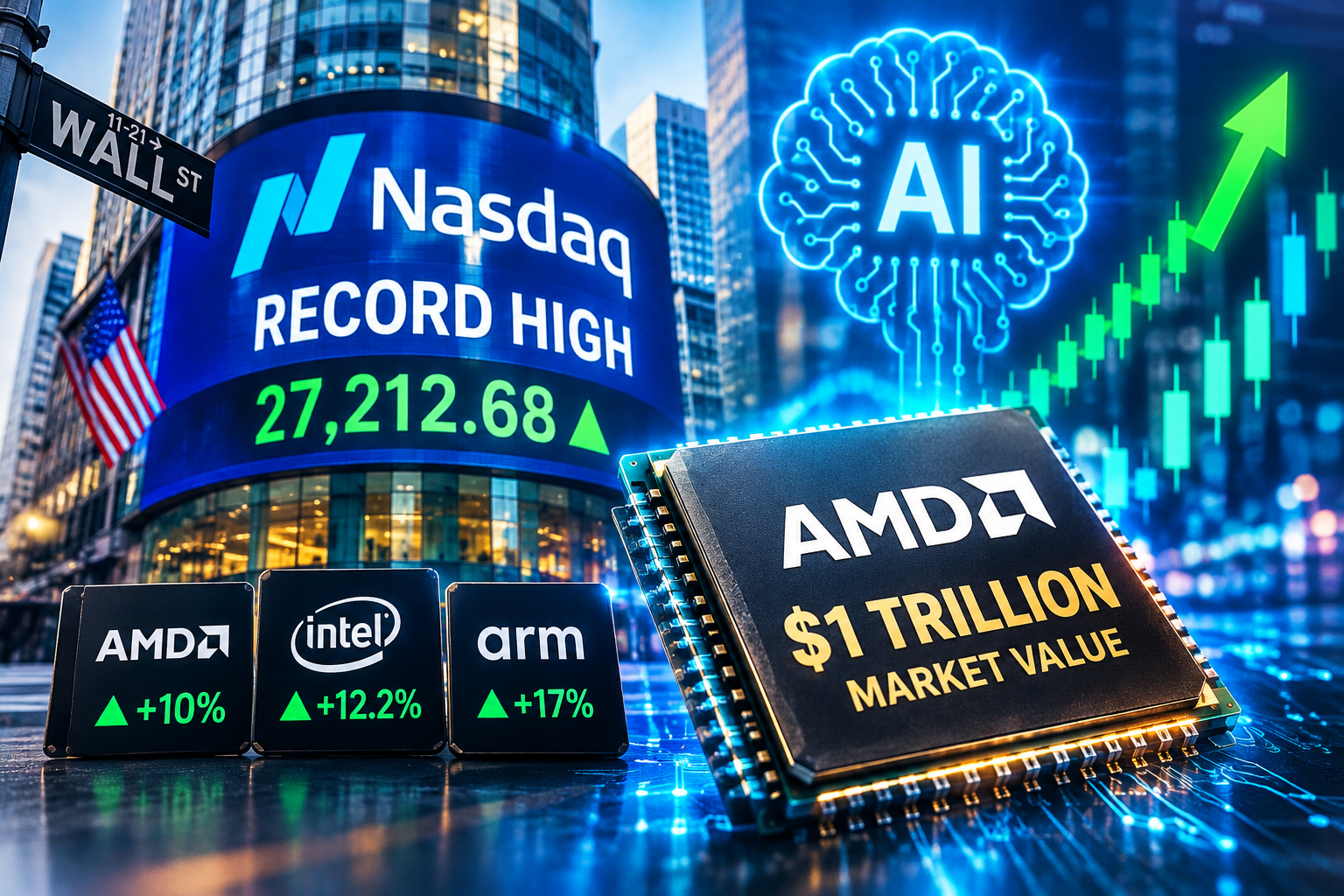
The Nasdaq Composite closed at a record 27,122.09, while AMD crossed the $1 trillion market-value threshold. Intel, Arm and other semiconductor stocks also recorded strong gains.
Then, on September 22, the Nasdaq reached another intraday record of 27,212.68, showing that the technology rally remained active.
The latest gains reflect renewed confidence in artificial intelligence and the companies providing the computing infrastructure behind it.
AMD’s strong data-center growth gives the company an important position in that story, while the broader semiconductor rally shows that investors are looking across the entire AI hardware ecosystem.
However, the long-term direction will depend on actual business performance.
AI spending will need to translate into revenue, earnings and wider adoption. Interest rates, oil prices, competition and market valuations will also continue to influence technology stocks.
For now, the latest Nasdaq records and AMD’s trillion-dollar milestone show that AI remains one of the most important forces shaping the US stock market in 2026.
Frequently Asked Questions
Why did the Nasdaq hit a record high?
The Nasdaq rallied as technology and semiconductor stocks gained strongly, supported by renewed optimism around artificial intelligence. Falling oil prices and lower Treasury yields also helped market sentiment.
When did AMD cross $1 trillion in market value?
AMD crossed the $1 trillion market capitalization level during Monday’s trading session on September 21, 2026. Reuters reported that AMD shares rose about 9.6% to a record $613.31.
What was AMD’s second-quarter 2026 revenue?
AMD reported second-quarter 2026 revenue of $11.536 billion, up 50% year over year. Its Data Center revenue reached approximately $6.7 billion, up 107%.
Which semiconductor stocks rallied?
AMD, Intel and Arm were among the major semiconductor stocks that gained strongly. Reuters reported gains of about 9.6% for AMD, 12.2% for Intel and 17% for Arm during Monday’s session.
Did the Nasdaq set another record on September 22?
Yes. The Nasdaq Composite reached an intraday record of 27,212.68 on September 22, surpassing its previous intraday record from June.
Why are semiconductor stocks important to AI?
AI systems require powerful processors, accelerators, memory and other computing hardware. As companies expand AI data centers and applications, semiconductor suppliers can benefit from increased demand for computing infrastructure.
Conclusion
The latest Nasdaq record high has put artificial intelligence and semiconductor companies back at the center of the US stock market.
AMD’s move above a $1 trillion market value is one of the biggest developments in the latest rally. Its strong data-center growth also provides a business foundation for the company’s expanding role in AI computing.
The wider gains in Intel, Arm and other semiconductor stocks show that investors are looking beyond a single company and focusing on the broader infrastructure required to support artificial intelligence.
At the same time, the market remains sensitive to interest rates, oil prices, valuations and corporate earnings.
The next major test will be whether continued AI adoption and spending can translate into sustainable revenue and profits. For now, the latest market data shows that artificial intelligence remains a major force behind technology stocks and one of the key business stories shaping the US market in September 2026.Stay Connected With Tech News